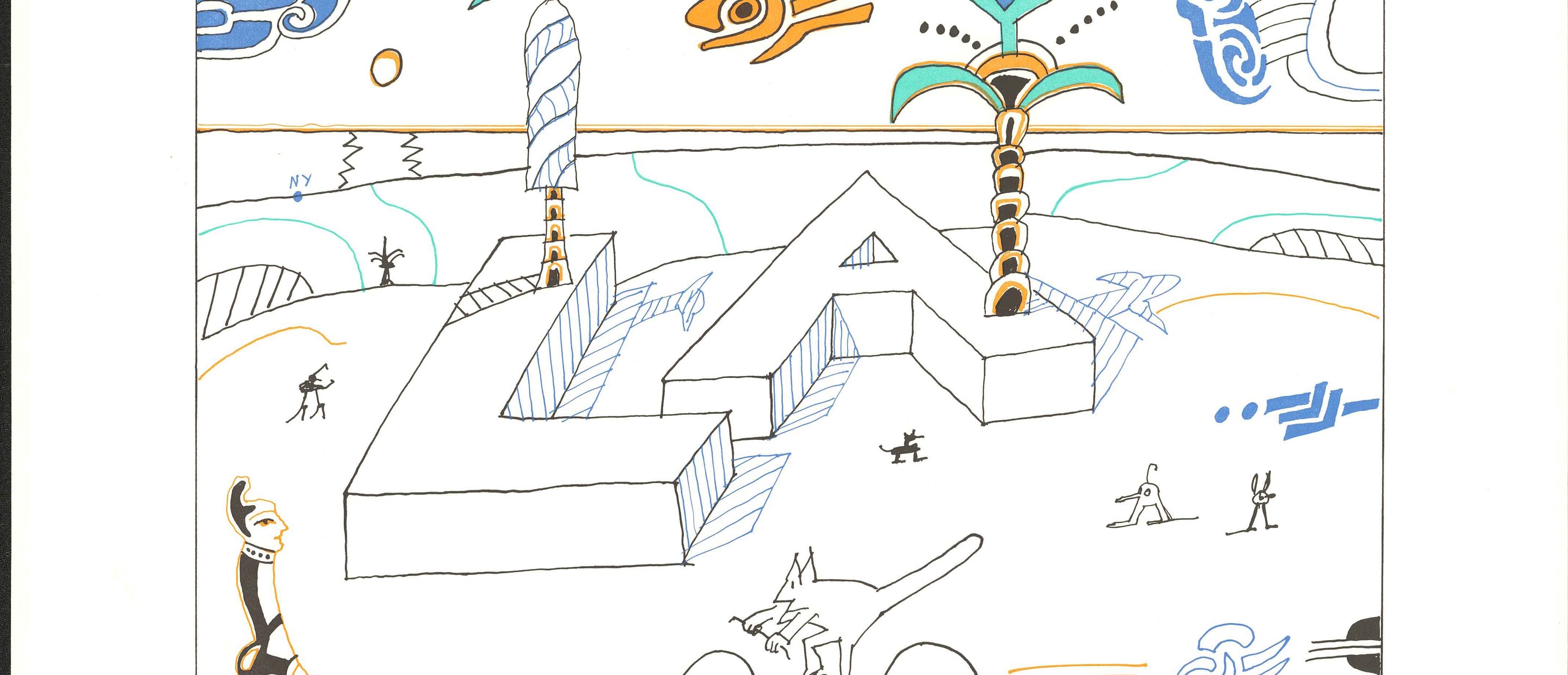
Claremont, CA—The Benton Museum of Art at Pomona College is thrilled to announce a gift of 76 works of art by Saul Steinberg from The Saul Steinberg Foundation, a nonprofit organization established by the artist in his will. The gift encompasses a wide range of two- and three-dimensional media—from prints and drawings to wooden objects—and celebrates Steinberg’s relentless creativity and transformative energy. Playful, poignant, and philosophical, these works demonstrate Steinberg’s constantly evolving artistic practice and his deep level of engagement with the people and objects around him.
“We are delighted and profoundly grateful to The Saul Steinberg Foundation for this tremendous gift,” said Victoria Sancho Lobis, Sarah Rempel and Herbert S. Rempel ’23 Director of the Benton. “Because the Benton is a vital part of a liberal arts college, we would like to think that our museum is an ideal setting for visitors to appreciate the full spectrum and process of an artist’s creative life. We are especially proud, in other words, to preserve and interpret not only the work for which Steinberg is best known, but also the kind of creative projects that best reflect his humanity and that can inspire young people in embodying the values of curiosity, exploration, and discovery.”
Saul Steinberg (1914–1999) is perhaps best known for his long association with The New Yorker magazine. Born in Romania, Steinberg began producing drawings for Italian humor newspapers while an architecture student at the Politecnico in Milan. The years just before and during World War II were tumultuous times for Steinberg. In 1941, he fled the racial laws in Italy and spent a year in Santo Domingo before arriving in New York in 1942. By 1943, he was commissioned in the Morale Division of the Office of Strategic Services, serving in China, North Africa, and Italy. He also created portfolios of drawings of military life in these locales, which were published in The New Yorker.
This period was only the beginning of a lifetime of prodigious and truly multimedia production. For the next five decades, Steinberg roamed the world, documenting his travels and thoughts in a fully individual style. He designed Christmas cards for the Museum of Modern Art and the Hallmark Company; his advertising work included a 1953 campaign for Jell-O; and he designed and executed murals, most notably for the US Pavilion at the 1958 World’s Fair in Brussels. He also designed theater sets and backdrops, including for Jerome Robbins, and the opening credits for Alfred Hitchcock’s The Trouble with Harry at the request of the director. He counted the most notable artists, writers, and thinkers of the twentieth century among his closest friends. “Let us call him ‘artist,’” said Philip Johnson when presenting Steinberg with an award for Eminence in Graphic Arts from the National Institute of Arts and Letters, “a visual artist who cannot fit definitions because he himself does not depend on words or definitions.”
The Saul Steinberg Foundation’s gift to the Benton is representative of this variety of expression and sheer volume of work. Included in the 76 works coming to the Benton are sketches of his wife, the artist Hedda Sterne, and later partner, Sigrid Spaeth; drafts of his drawings; and prints, plates, and artist’s proofs from across his career. Specifically related to the Benton is the gift of Steinberg’s wood replica of a book by artist and Pomona alumna Marcia Hafif ’51: Pomona Houses, a volume of photography preserving the area’s residential architecture.
The gift includes more of Steinberg’s wood constructions, including decorated candy boxes (a nod to his father’s profession), a genre that became increasingly important to him in the 1970s. During that time he began to create his Drawing Table Reliefs—carved and painted trompe-l’oeil wood objects on panels that represented his immediate surroundings and tools of his trade (the objects on his drawing table) as well as reiterations of his own work. The series was both a glimpse inside his daily life—even the food he ate—and a reflection on his past work.
The Benton is planning an exhibition of selected works from this gift in the fall of 2026, highlighting not only the scope of the gift but the Benton’s sustained commitment to the stewardship and advancement of the study of works on paper.