Asian Languages and Literatures
Learning Objectives
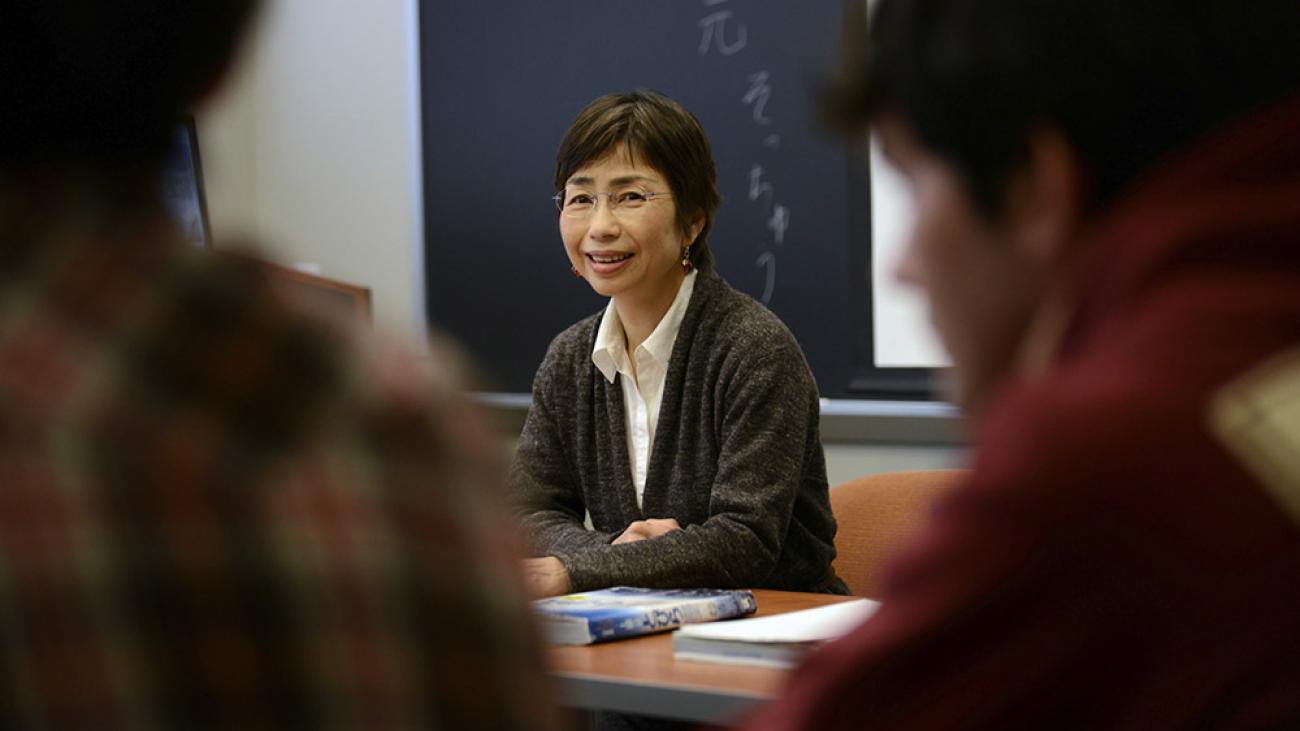
The objective of a major in Asian Languages and Literatures is to develop advanced language skills and to provide an introduction to the literary and cultural traditions of China and Japan, from early times to the present day. The emphasis is on oral proficiency, as well as literacy, in either Chinese or Japanese. Upper-division classes develop analytical skills through the critical study of literary texts.
To foster an awareness and understanding of Asian cultures, departmental courses are often interdisciplinary in approach, introducing historical background, social, philosophical, and political issues, and other cultural concerns. Students are also encouraged to broaden their knowledge of China and Japan by taking courses in other disciplines in the Asian Studies program. Many students of Chinese and Japanese study for a semester or more in China and Japan; opportunities currently include programs in Nanjing and Taipei, Kyoto and Tokyo. A multimedia center, with state-of-the-art audio, computer, and video equipment and a growing film library, further enriches the study of Asian languages, literatures, and cultures.
Department Learning Goals for Chinese and Japanese Majors
Students who graduate with a major in Chinese or Japanese are expected to be proficient in their chosen language and to have a solid grounding in the literature and culture of China or Japan. By proficient in the language, we mean to be capable of speaking fluently with good grammatical, lexical and cultural accuracy in formal and informal speaking styles; reading authentic texts such as literature, newspapers, and magazines; understanding spoken language in daily conversations, public speeches and media; engaging and discussing cultural values and assumptions in readings and mass media; translating a short story, essay, poetry, or excerpts from news, film and other media, writing accurate and meaningful reports and descriptions in formal written prose, and letters and notes in formal and informal language; and, in the case Chinese majors, reading classical Chinese texts of moderate difficulty, and , in the case of Japanese majors, reading annotated texts in classical Japanese. By a solid grounding in the literature and culture of China or Japan, we main a knowledge of classical and modern literary texts, films, and other media; ability to analyze and interpret texts in an informed and sensitive way, both orally and in writing; understanding and experience of cultural practices, enabling successful interaction in a Chinese or Japanese cultural environment; and the ability to undertake and implement independent research, showing a command of primary and secondary sources.
Department Learning Goals as Reflected in the Senior Exercise
The senior exercise requires students to combine a high level of ability in Chinese or Japanese language with an understanding of literature and culture. In Chinese, students must, with guidance and correction, translate into English Chinese literary texts (a short story, poems, or extracts from a novel, play, or memoir) from both the modern and the pre-modern eras. Japanese majors normally do an integrated, thesis-like project-conducting a translation in the fall and a complementary analytical study in the spring. In either language, majors must demonstrate an understanding of the context, value, and importance of the texts under examination; locate and employ relevant secondary sources relating to the author(s) and work(s) in question; and demonstrate familiarity with basic reference works and academic resources useful in the reading and study of the target literature.
| Name/Contact | Title | Profile | Web | Phone | Location |
|---|---|---|---|---|---|
| Allan Barr | Chinese Coordinator, Professor of Chinese | (909) 621-8934 | Mason 219 | ||
| Eileen Cheng | Associate Professor of Chinese | (909) 607-7109 | Mason 208 | ||
| Peter Flueckiger | Japanese Coordinator, Associate Professor of Japanese | (909) 621-8936 | Mason 204 | ||
| Sharon Hou | Associate Professor of Chinese | (909) 621-8935 | Mason 211 | ||
| Kyoko Kurita | Department Chair, Professor of Japanese | (909) 621-8933 | Mason 203 | ||
| Claire Li | Lecturer | (909) 607-0717 | Mason 213 | ||
| Lynne Miyake | Professor of Japanese | (909) 621-8931 | Mason 205 | ||
| Mariko Omori | Lecturer of Japanese | (909) 621-8618 | Mason 210 | ||
| Kazumi Takahaski | Adjunct Associate Professor of Japanese | (909) 621-8928 | Mason 209 | ||
| Tamaki Terada-Landis | Lecturer of Japanese | (909) 607-7110 | Mason 218 | ||
| Jianhsin Wu | Adjunct Professor of Chinese | (909) 621-8940 | Mason 207 | ||
| Hong Yao | Lecturer of Chinese | (909) 621-8621 | Mason 212 |
| Name/Contact | Title | Profile | Web | Phone | Location |
|---|---|---|---|---|---|
| Stanleigh Jones | Emeriti Professor of Japanese | (909) 607-8556 | 104 Baldwin House |
| Name/Contact | Title | Phone | Location |
|---|---|---|---|
| Denise Miller | Academic Department Coordinator | (909) 621-8616 | Mason 231 |
Mailing AddressPomona College, Asian Languages and Literatures, 550 N. Harvard Avenue, Claremont, CA 91711
Phone(909) 621-8616
Fax(909) 607-3596
Campus LocationMason 231