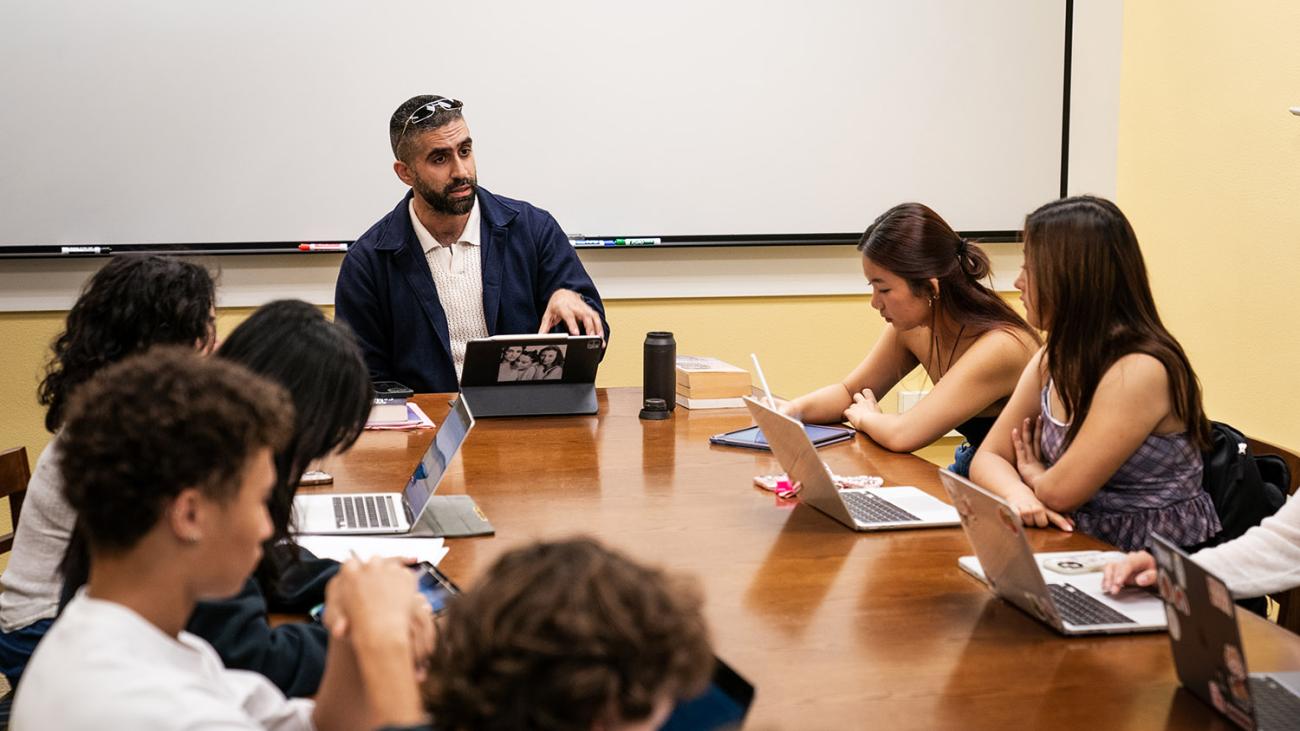
In class with Omer Shah

In class with Cécile Evers

In class with Alexandra Lippman
Study human societies and the cultures they create across time and geography, including how they develop and change.
Anthropology in the broadest sense is the study of humankind, across time and around the world. At Pomona, our anthropologists are currently investigating the knowledge and practices affecting human health, how multilingual creativity can challenge racism, religious infrastructures and logistics, and the politics of digital culture and music.
Anthropologists base their research on in-situ engagement with people in the places where they live. This method, known as ethnography, helps to understand the experiences, local meanings, and histories relevant to particular communities.
Anthropology has since its founding also encompassed several theoretical and methodological orientations, permitting a holistic approach to the experiences and challenges of people worldwide. Through insights gleaned from biological anthropology, sociocultural anthropology, linguistic anthropology, and archaeology, anthropologists can offer great insight into current societies and offer a range of solutions to pressing challenges. Ethical concerns, from equity and equality to social justice, motivate anthropologists in their conduct of ethnography as much as gaining new theoretical perspectives.
At Pomona, the anthropology major is designed to offer breadth in the discipline and majors are encouraged to study abroad or engage in a summer field program to gain experience in a culture other than their own. Your senior exercise may be based on original ethnographic fieldwork conducted during time abroad, during funded summer research (e.g., SURP, PCIP), or throughout the first months of senior year.
If you are interested in careers in which anthropological training is applied to problems of public policy, you may choose to major in public policy analysis with an emphasis in anthropology.