Pomona Student Cruises to Hawaii as Part of NSF-Funded Research Team

Three members of the Pomona research team stands in front of the research ship in San Diego harbor.

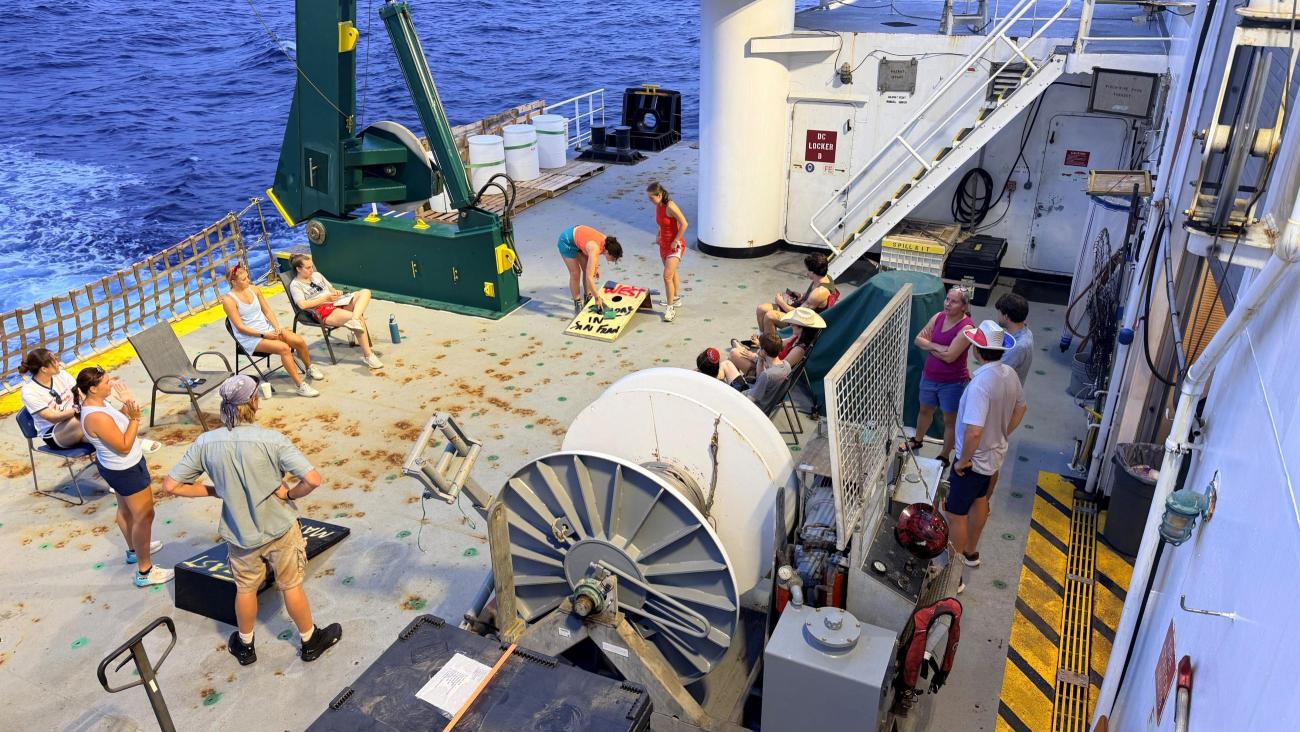
Elle Hawthorne ’29 spent a month this summer on a dream cruise to Hawai’i, watching manta rays and flying fish, and seeing white-tipped sharks hunt mahi mahi. But there were no buffets and lounge chairs on the RV Kilo Moana as it powered its way from San Diego to the Aloha State.

Instead, there was the energizing company of 17 ocean scientists and the satisfaction of collecting data as part of a major research project, even though Hawthorne had only just finished her first year at Pomona College.

“It still feels surreal,” she says. After one year of college, “being able to get real firsthand research experience, being able to go to sea—that’s just the coolest thing ever.”

Hawthorne’s work as a research assistant with Maria Prokopenko, visiting assistant professor of geology, received support from Pomona’s Summer Undergraduate Research Program (SURP), which provides a generous stipend for up to 10 weeks working with a professor or on an independent research project.

One of the advantages of being part of a major scientific investigation, Hawthorne discovered, is learning from research scientists from several institutions.

At first she felt intimidated to be surrounded by such knowledgeable experts. “But everyone was so nice and so eager to help and explain things,” she found. “I learned just as much in casual conversation as I did actively working in the lab.”

Investigating ocean “deserts”

Prokopenko is co-principal investigator on a project funded by the National Science Foundation Chemical Oceanography Program, with colleagues from the University of New Hampshire, Texas A&M and the University of Minnesota. One of the team’s main goals is to unpack how nitrogen required for photosynthesis—in a microscopic form of algae known as phytoplankton—travels great distances from nutrient-rich waters to support life in vast, remote ocean “deserts” such as the North Pacific Gyre, the target of the research team’s study.

Phytoplankton is a vital part of the oceanic ecosystem, Prokopenko explains with a farm analogy: “Phytoplankton are the plants, and then there are zooplankton that are like little cows of the sea eating the plants.” Larger animals then eat the zooplankton, and the cycle continues up the marine animal food chain.

Not only does phytoplankton serve as the foundational food source in the ocean, its photosynthesis is believed to generate half or more of Earth’s oxygen.
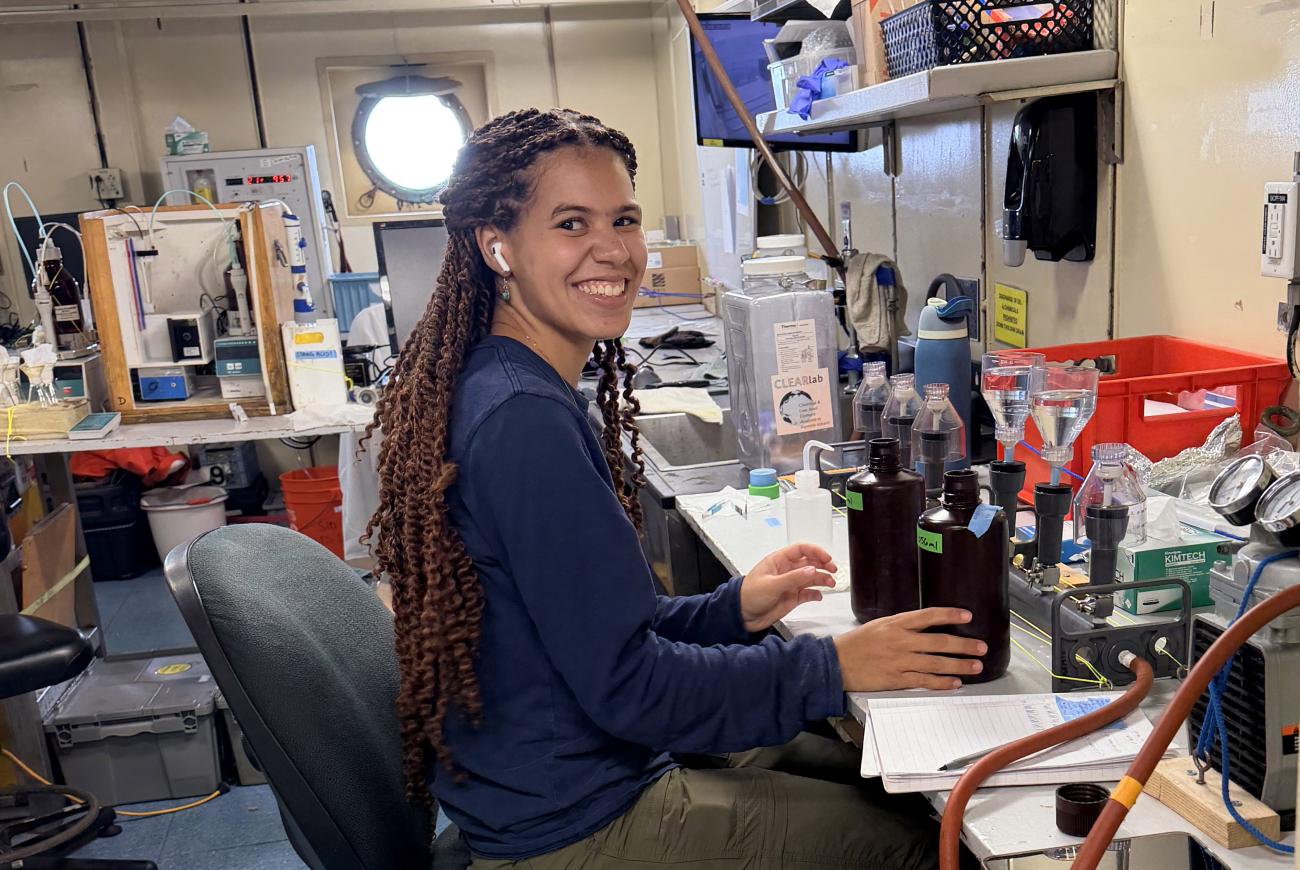
Expand the image: Elle Hawthorne seated at a table filled with scientific instruments on board a research ship.
Elle Hawthorne seated at a table filled with scientific instruments on board a research ship.

Elle Hawthorne ’29 learned to filter particulate organic matter for chemical analysis.

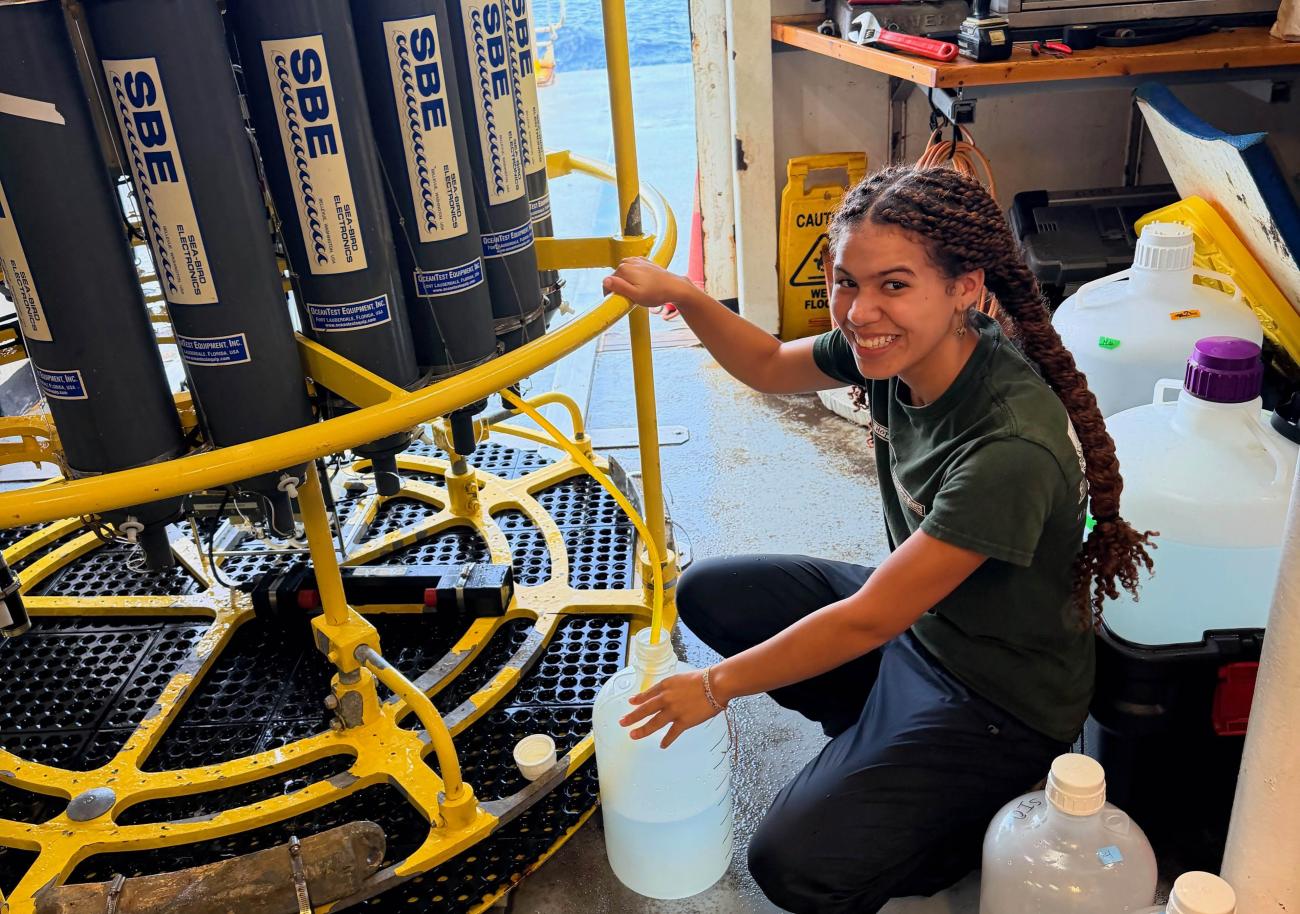
Expand the image: Elle Hawthorne samples water from a CTD rosette.
Elle Hawthorne samples water from a CTD rosette.

Hawthorne collected water samples from the CTD Rosette at pre-determined stations.

Scientific evidence is mounting that dissolved organic nitrogen (DON) is the primary source of nutrients that make it possible for photosynthesis to occur in seeming ocean deserts. Prokopenko’s work helps calculate the rate of phytoplankton growth in these regions, while other researchers seek to understand whether DON is indeed the vital nutrient and how it moves great distances to get there.

Science at sea

Data collection got underway as soon as the ship set off June 21 on a path that took it nearly to the equator off the coast of Ecuador, then northwest to the Hawaiian Islands. By design, it passed through nutrient-rich and nutrient-poor areas of the North Pacific.

Over the preceding year, Prokopenko and technician Austin Cordova had specially designed and built an Equilibrated Inlet Mass Spectrometer, which took water pumped from under the ship and continuously measured the oxygen-argon ratio of the surface water.

Since oxygen is a product of photosynthesis, this data enabled the research team to calculate the amount of photosynthesis taking place across the ocean surface along the ship’s entire path.

For a second research dataset, a member of the Pomona team—Hawthorne, Prokopenko or Pitzer College student Charlotte Renner—drew water samples from the ship’s pathway every four hours around the clock to measure nitrous oxide levels.

Then, at 13 pre-determined stations spaced roughly two days’ journey apart, Hawthorne and Renner gathered samples from a water column up to 15,000 feet in depth to see the concentration of particulate organic nitrogen, phosphorus and carbon.

In total, they filtered and labeled about 2,600 liters of seawater from the water column, now being analyzed in a lab.

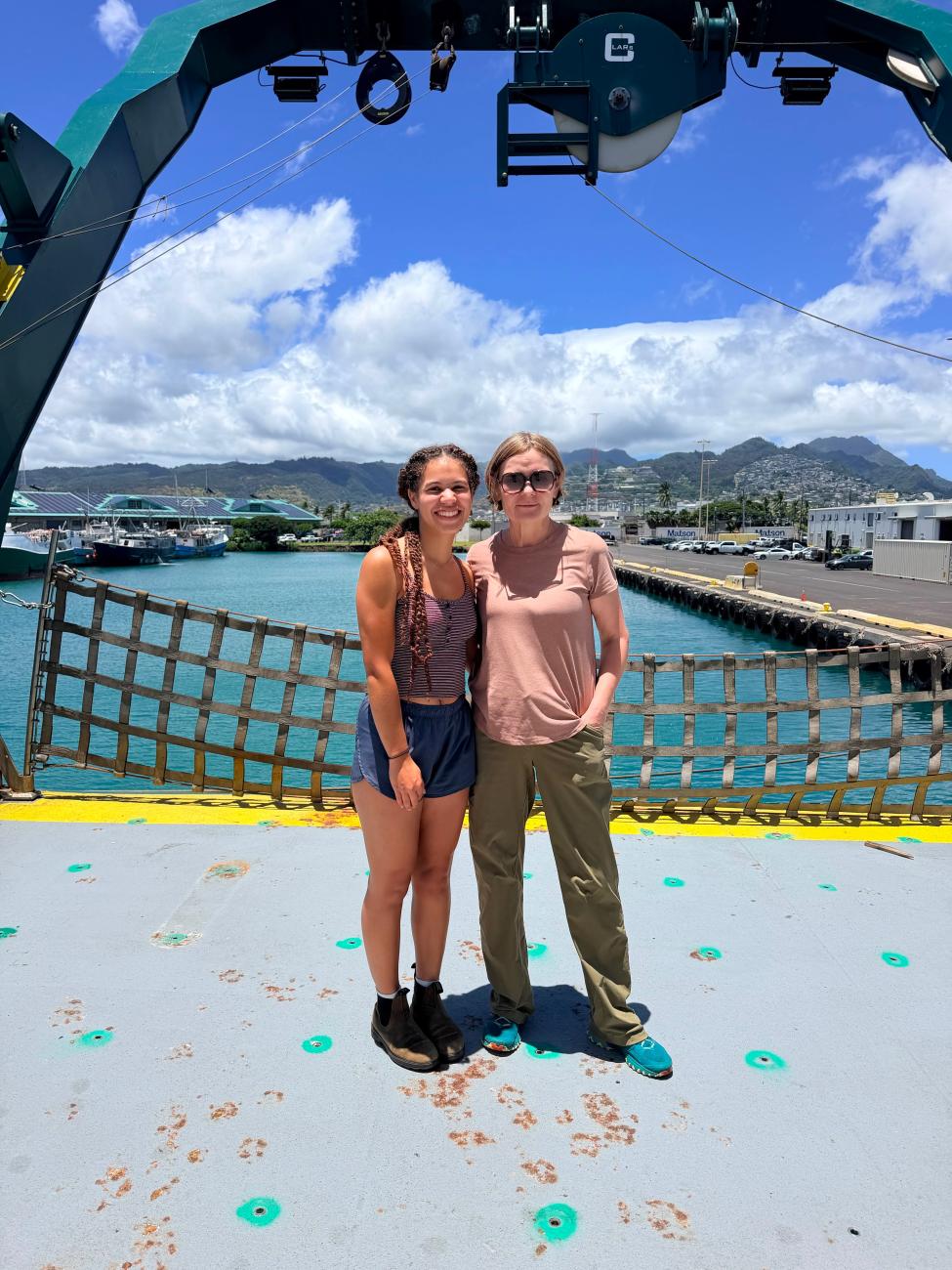
Expand the image: Elle Hawthorne and Masha Prokopenko on ship deck as they land in Honolulu.
Elle Hawthorne and Masha Prokopenko on ship deck as they land in Honolulu.

Elle Hawthorne ’29 (left) and Prof. Maria Prokopenko landing in Honolulu.

As the cruise continued, Hawthorne became comfortable asking the more experienced scientists about things she didn’t understand.

“Sometimes they didn’t understand it either,” she discovered. “Voicing when something didn’t make sense actually ended up benefiting everyone because then we had more things to explore.”

Cruising toward a STEM career

On July 22, a full 31 days after last seeing land, Hawthorne was excited to arrive in Honolulu. She helped unload the samples and equipment, then headed out to enjoy two days of well-earned tropical vacation.

For Hawthorne, the adventure may be career-defining. It definitely solidified her interest in pursuing a geology major.

“There’s just so much we don’t know about the ocean,” Hawthorne says. “I was reminded how vast it is ... and how much we still have to learn.”