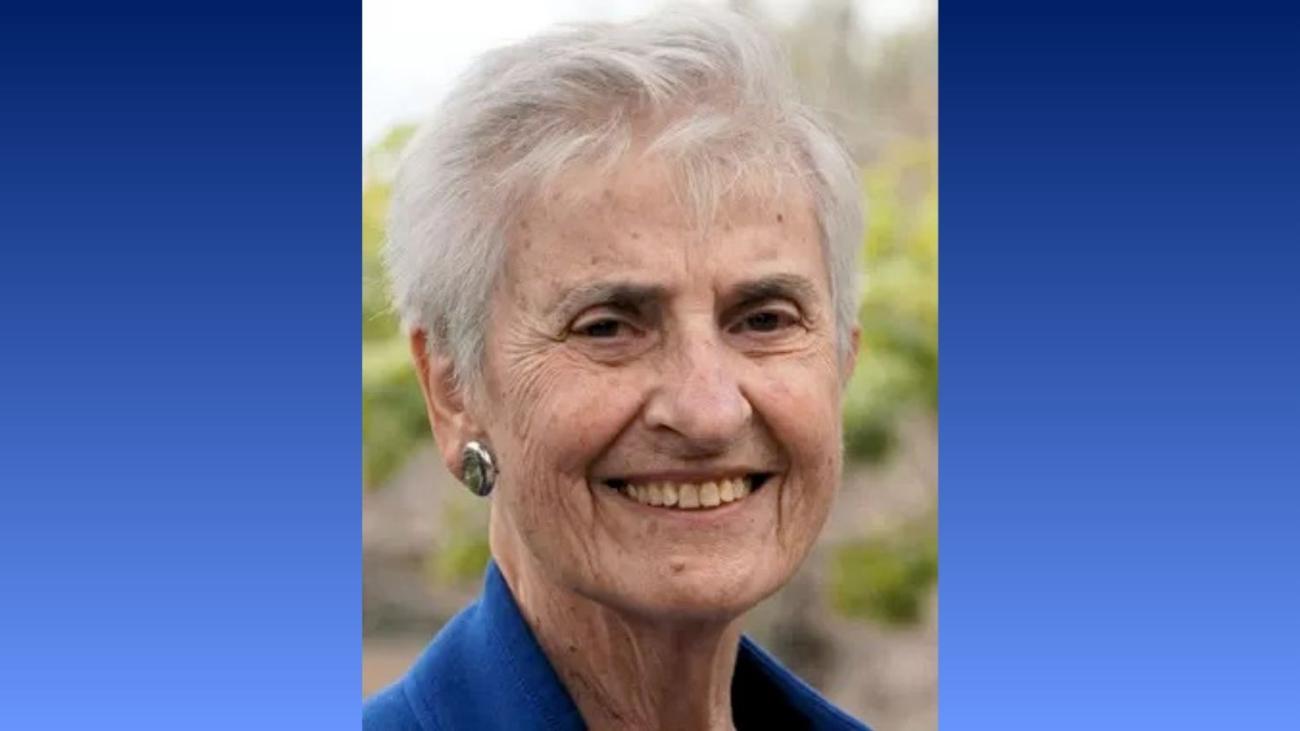
A moment of chance brought Anne Bages to Pomona College — sparking a 44‑year run that helped shape women’s athletics and Oldenborg history.
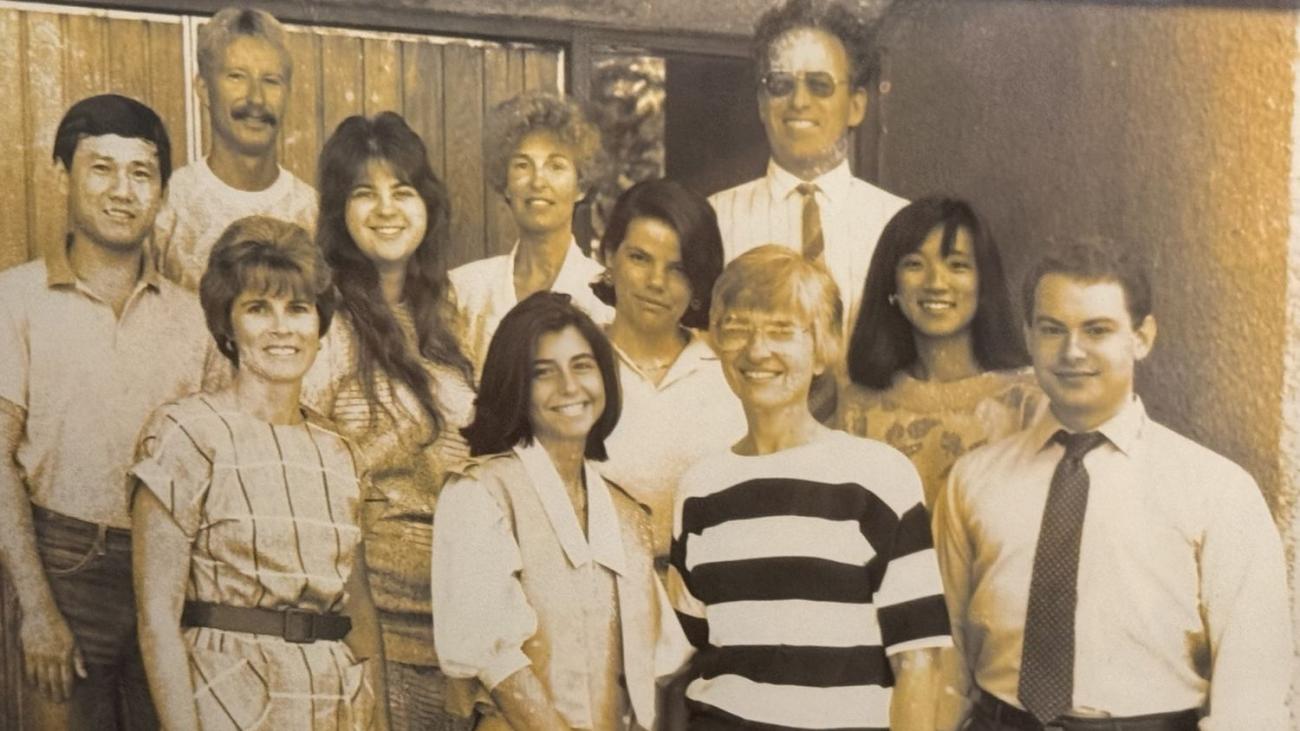
Bages (bottom row, third to left) with Oldenborg language residents, 1988-1989.
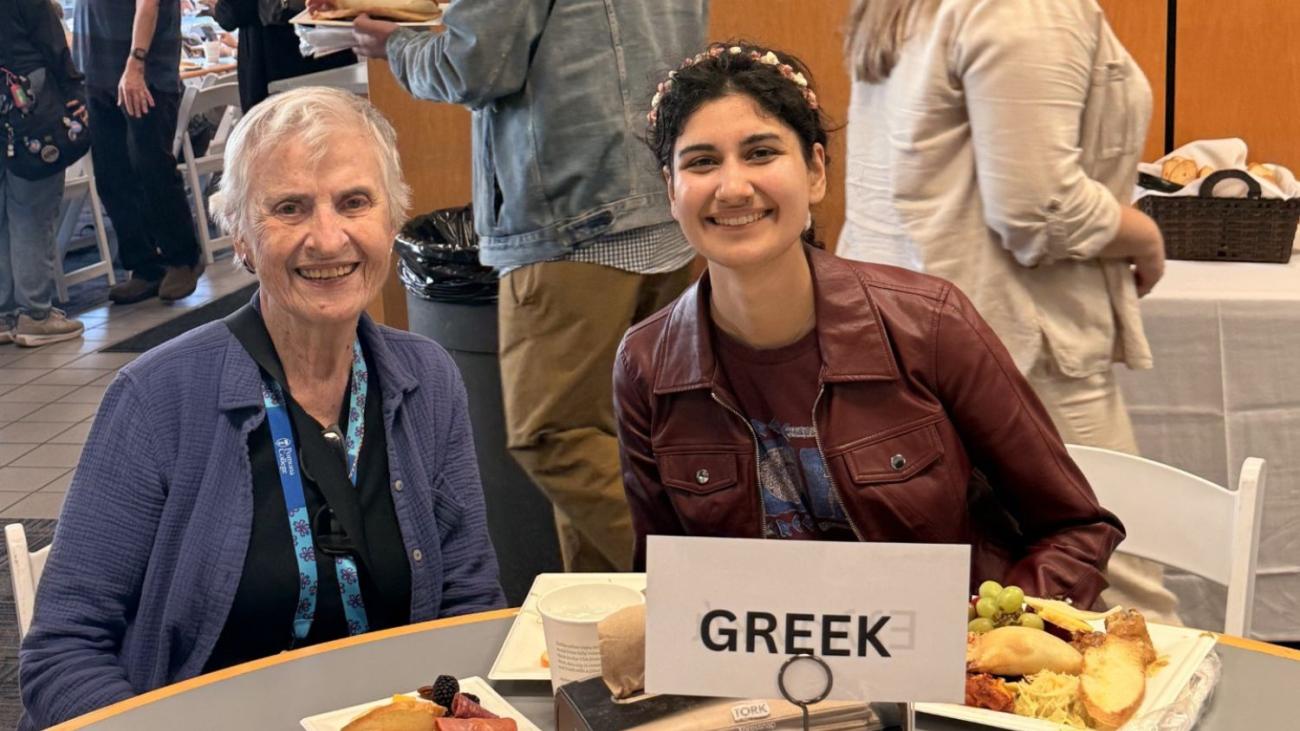
During the Oldenborg Open House at Alumni Weekend, Bages returned to the Greek table where Maria-Sophia Sotiropoulou ’28 discovered they share roots in the same small village in Greece.
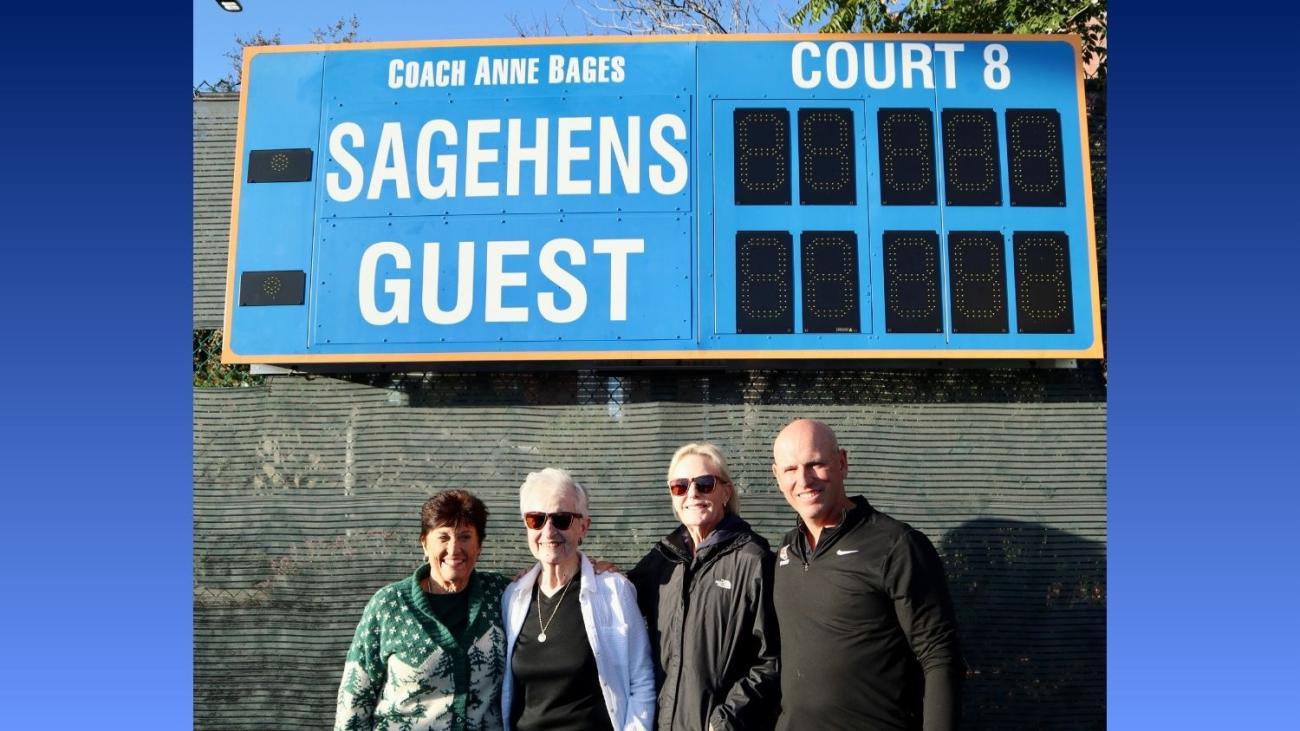
Bages (second from left) celebrates her namesake scoreboard at the Pauley Tennis Complex with former coaches Dr. Ann Lebedeff and Lisa Beckett and current coach Mike Morgan.
Anne Bages was sitting among fellow teaching assistants at UCLA in Westwood, Calif., when the physical education department chair walked in with an opportunity for a one-year job opening at Pomona College.
She flipped a coin.
Heads, she would take the job. Tails, she would not.
“It came up as heads,” Bages says. “At the time, I thought I lost.”
That chance moment became the start of a 44-year career at Pomona — one that would help shape two defining parts of the College’s history: the rise of women’s athletics and the enduring legacy of the Oldenborg Center for Modern Languages and International Relations.
With the College on the heels of a new era with the Center for Global Engagement, we sat down with Bages, emeritus professor of physical education — now 91 years old — who was integral in writing Oldenborg’s early chapters.
Early Life at Pomona
Bages arrived at Pomona in 1959 as a physical education instructor at a time when opportunities for women in collegiate athletics were extremely limited and often informal. Pomona was no different. But over the next 25 years, she helped build a program at the College which today has earned multiple Division III national championships in women’s sports and the 2024 NCAA Woman of the Year — a first for Pomona.
As the women’s tennis coach, Bages grew the program from local tournaments to national prominence, culminating in a sixth-place national ranking in 1984.
She later served as chair of the Department of Physical Education and became the first woman to serve as the College’s athletic director. She also played an integral role in Pomona’s implementation of Title IX, the landmark federal ruling that prohibits sex-based discrimination in any education program or activity receiving federal financial assistance.
“Opportunities for women in athletics weren’t a given — they were something we had to advocate for, and in many cases, build ourselves,” says Bages.
That instinct would later define her next chapter.
The Oldenborg Years
In 1984, she brought that same spirit to a different kind of leadership role as director of the Oldenborg Center.
For nearly two decades, Bages guided a place unlike any other on campus — a residential, academic and dining community built around language and cultural immersion.
“The job was fun, but it was hard,” she says. “It required being present in so many ways —working with students, language residents, faculty and staff all at once. But that is what made it so meaningful.”
Born to Greek immigrant parents and raised speaking their native language until the first grade, Bages brought her own understanding of language-learning to the role, even hosting her own Greek language table.
What she found when she first arrived were students approaching language with hesitation — preoccupied with grammar rules and wary of making mistakes. Changing that dynamic, she says, was her first order of business.
“Learning a language is already hard,” Bages says. “No one should have to learn while being afraid.”
Drawing on her background as a coach, she reshaped language table culture — making the conversations less rigid and rooting the discussions in participation rather than perfection.
“Everything takes practice. You can’t perfect something the first time, or even the second,” Bages says. “You improve by showing up, trying, making mistakes, and continuing anyway.”
This philosophy continues to shine through today, embedded in the daily life of the center.
“Despite the four decades between us, Anne’s legacy remains remarkably present,” says Senem Bakar, interim director of the Oldenborg Center. “At the time when she was director, the center was just coming of age, and yet, Anne established many of the policies and practices that continue to guide Oldenborg to this day.”
The Heart of Oldenborg
At the center of Oldenborg are its language residents — university graduates from around the world who live among students, lead conversation courses and bring their culture to life through daily interactions.
For Bages, those relationships extended well beyond her role as center director.
She met every resident at the Los Angeles airport when they first arrived in Southern California. She hosted them in her home, attended their weekly meetings and even traveled to their homelands in the summer.
Over time, the residents she encountered reflected the breadth and unpredictability of the world itself — among them a tour crew member for the Red Hot Chili Peppers and the child of a Russian spy.
But what stayed with Bages was not the novelty of their stories. It was her connection with them.
“Oldenborg was never just about language to me,” Bages says. “It was a space that made people from every corner of the world feel like they belonged.”
Looking Ahead
Now, as Oldenborg prepares to make way to the Center for Global Engagement (CGE), Bages reflects on its legacy with both pride and great hope for the future.
“Oldenborg was great in character,” she says. “But not in practicality.”
The CGE will expand on Oldenborg’s legacy with a purpose-built space designed for the next era of global learning — bringing together residence halls, dining, language study and flexible academic spaces in a way that expands the model Oldenborg helped pioneer.
“I’m excited for a space that is built for what it is meant to do,” Bages states.
Looking back, Bages says she sees her time at Pomona not simply as a career, but a life shaped by chance.
As for that coin toss years ago?
“I don’t think I lost. It turned out to be quite the lucky coin flip.”
This story is part of our “Dear Oldenborg” series, as Pomona College bids farewell to the center. Visit our webpage to read more.