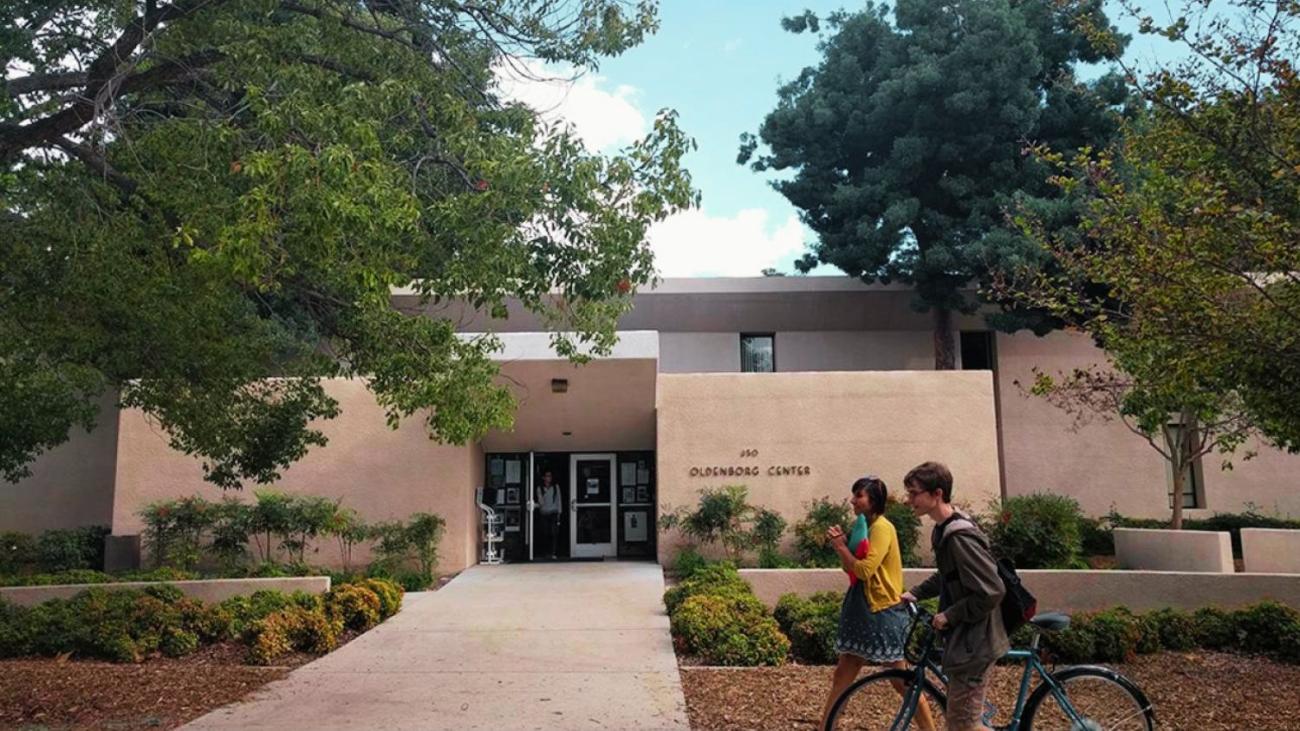
Since the 1960s, International Relations at Pomona has grown alongside Oldenborg, a pioneering center for language, international living and coeducation.
For Laura Jaramillo Martínez ’25, leaping into an upper division course on the international relations of East Asia as a freshman set her off into an unexpected and rewarding direction.
“What could have been intimidating became one of my most formative experiences at Pomona,” Jaramillo Martínez says. “Professor Tom Le challenged my preconceptions and opened my eyes to new perspectives on regional politics and global security.” Le also helped Jaramillo Martínez secure an internship at the Pacific Forum, a Honolulu-based foreign policy research institute, where she studied transnational repression, AI readiness and disinformation as an undergrad.
“I chose to major in international relations (IR) because of my fascination with how history, power and memory shape our world,” Jaramillo Martínez says. “Instead of feeling restricted, the major became an open invitation to explore new ideas, connections and perspectives.”
Jaramillo Martínez — who is now pursuing a joint master’s degree in international and world history at Columbia University and the London School of Economics — is just the kind of cosmopolitan student that is attracted to international relations at Pomona, according to Colin Beck, professor of sociology and vice chair of international relations.
“International relations at Pomona is distinguished by being a multi-disciplinary program that includes history, economics, politics, sociology, anthropology and area studies,” Beck says. “This makes us unique in that we are not just imitating the subfield of international relations within political science.”
On the vanguard from the start
International Relations has existed as its own discipline at Pomona since the 1960s, emerging at about the same time that the Oldenborg Center was founded.
Emeritus professor David Elliott joined the Pomona faculty in the mid-1970s. “At that time, the nature of the field was changing,” he says. “It was not just interdisciplinary. It required that faculty in the politics department in charge of international relations were experts not only in their own field but also were knowledgeable in economics — considered a key area in the field of IR study.”
Some faculty members joined the program later and they helped reinforce the interdisciplinary approach — among them, Steven S. Koblik, a scholar of modern European diplomatic history, and David Arase, an expert on East Asian affairs with a focus on Japanese politics and foreign policy. Another key person was Stephen Marks, a theoretical economist who chaired the IR Program in the 1980s and who continues as an associate dean of Pomona College today.
“Pomona was on the vanguard of developing this method of teaching in International Relations,” Elliott says. “Its strength in foreign languages and culture reinforced this approach. Oldenborg was a uniquely important component of that vision.”
When Oldenborg Center was built in 1966, it was the first facility of its kind to combine a language center, international house and coeducational residence in a single building. Although other institutions, Columbia and Berkeley among them, had international centers for foreign students, and many others held modest language houses, no other American college or university offered a dormitory designed for the practice and use of foreign languages.
Betsy Crighton, emerita professor of politics, says, “Pomona has long emphasized the importance of language to someone’s ability to function in another country.
“That is a strong commitment of the language and literature departments, of IR, and of Oldenborg — and I’m so glad that it’s being preserved,” says Crighton, a Europeanist who was an active part of Pomona’s international relations program expansion in the 1980s.
“I think it’s crucial to preparing our students for the global world we live in, particularly as language programs at many colleges are being cut.”
Clambering for new options
“The major has undergone an evolution that reflects some of the changes we’ve seen in global politics,” says Heather Williams, a professor of politics who joined Pomona in 1998. “A lot of early international relations work was basically focused on security analyses of the U.S. and the Soviet Union,” she says. “By the time I joined, there were all kinds of new questions about what was going on in southeast Europe; and how did we understand the war and peace process in places like Croatia or in Bosnia-Herzegovina.”
There was also a great deal of enthusiasm about the number of new democracies that had emerged in the world. “Many of my first students had early memories about the fall of the Berlin Wall,” she said. During this time, the College raced to expand international relations from a relatively narrow focus on nuclear proliferation and conventional forces in western Europe to thinking about the global south.
Pomona students began clambering for options to study in Latin America, in places like Argentina, Chile, Brazil and Ecuador. They took advantage of opportunities to study in Cuba and other uncommon locations like Rwanda and South Africa.
“There were a lot of students who wanted to learn languages we didn’t offer at Pomona College,” Williams said. “But through Oldenborg, people got access to the language tables. And if they were learning Farsi, for example, these were great things they could share.”
For Jaramillo Martínez, she already knew she was interested in Latin American politics when she started at Pomona. She was also a native Spanish speaker. But as she expanded into new geographic zones of interest, she took advantage of Oldenborg Center resources to help build her comfort and proficiency in new languages and cultures.
Her international relations major required her to study abroad for at least one semester and take classes in one or two languages. She chose a semester abroad in Seoul, South Korea, focusing on international relations of the Korean peninsula while also pursuing her passion for architecture.
“The Oldenborg Center was very special to me during my time at Pomona. I not only lived there my second year, but I genuinely loved meeting faculty and students from all corners of the Claremont Colleges,” Jaramillo Martínez says.
“I attended the Korean, Spanish and Italian language tables and enjoyed the events organized by the language residents, including one where we made Chinese sweets for Chinese New Year. It was a bonding experience and many of the friends I made from Oldenborg are still very close to me today.”
Many career paths available
Today, international relations is among the most credit-intensive and rigorous majors at Pomona College. Students particularly appreciate the opportunity to commit to an intensive year-long senior thesis, Beck and Williams both say.
“In recent years, we’ve had students do interviews of policy makers, statistical analyses, archival research and fieldwork abroad,” Beck says. “They’ve done case studies on online recruitment by terrorist organizations, securitization of immigration policy in the Caribbean and the Mediterranean, international maritime disputes, collective action in rural Brazil, the potential of green energy in Africa, populism in Hungary, China’s belt and road initiative, anti-nuclear movements in Kazakhstan and more.”
Pomona is among the top 50 U.S. colleges and universities — of all sizes — with career diplomat graduates. But that’s not the only choice available for its diverse group of international relations majors.
Common career paths include public service, non-governmental organizations, business, law and academia. Intrepid individuals have succeeded in other fascinating and niche roles, such as award-winning international correspondent Maggie Fick ’07 and Japan-based urbanist Sam Holden ’12.
“This major has opened more doors than I ever imagined,” says Jaramillo Martínez, who plans to work at the intersection of international politics and historical memory after she finishes her graduate studies. “International relations has felt more like a community than just a major, shaping both my academic journey and who I am.”
This story is part of our “Dear Oldenborg” series, as Pomona College bids farewell to the center. Visit our webpage to read more.