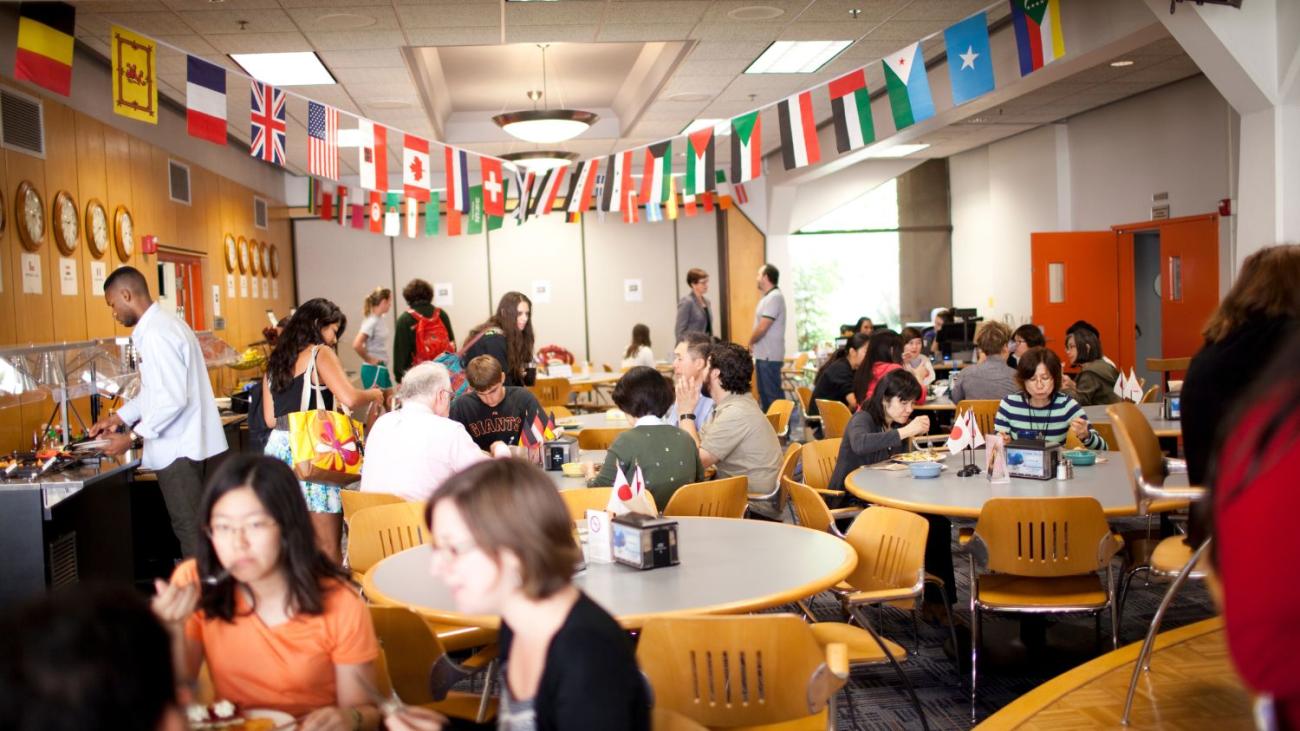
For 60 years, the Oldenborg dining hall language tables have served as a daily gathering place, bringing community members together through conversation and shared meals.
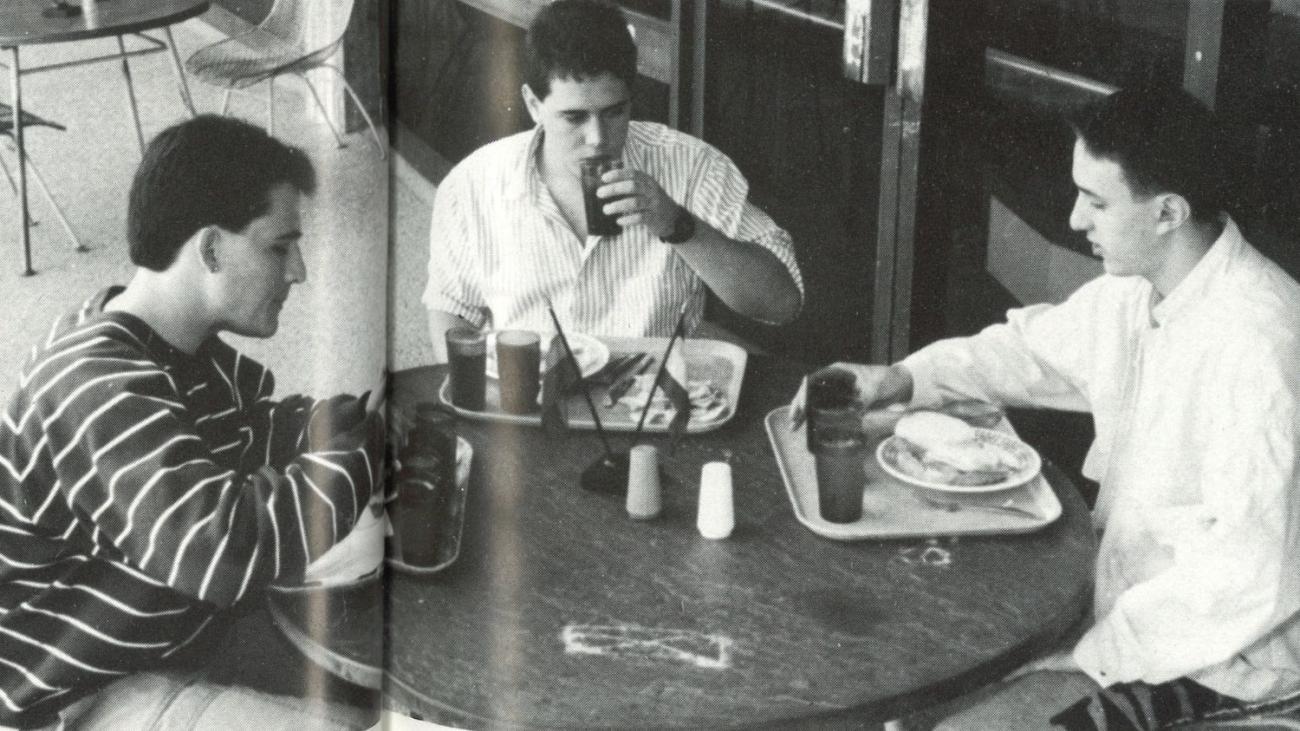
Three students eat at the language tables in 1990. The program has long been open to students, staff, faculty and the public.
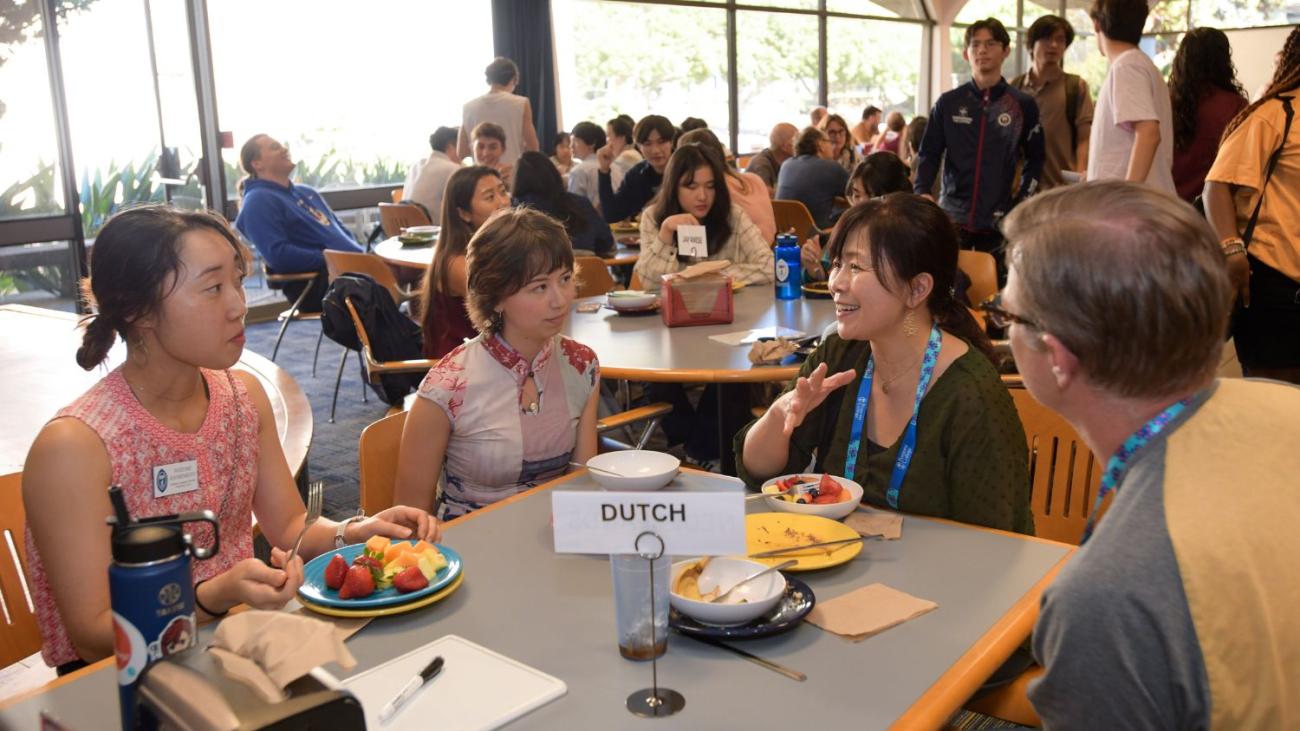
Alumni Weekend 2026 will mark one final opportunity for alumni to join students and community members for a meal at the Oldenborg language tables.
A daily staple since the Oldenborg Center opened, the Oldenborg dining hall language tables have been serving up conversation and community for 60 years. During this academic year, Pomona offered language tables for 30 different languages. As the campus makes room for the construction of Pomona’s new Center for Global Engagement, the language tables will be held in Frank Blue Room starting in the fall of 2026.
Even as the physical backdrop changes, Pomona will continue to lean into a familiar recipe for success. Countless students have developed and maintained their language proficiencies by following a time-honored daily ritual: Fill up a tray, look for the language sign, and then set aside English — for the entire lunch hour.
Just that one hour at the language tables makes a huge difference. “It’s really obvious,” says Anne Dwyer, associate professor of German and Russian at Pomona College. “From a language learning perspective, you can tell who goes. The students who participate are exposed to so much more. Their listening comprehension is better. And they lose their fear of speaking faster.”
But the benefits go beyond simple conversational proficiency. A lot of cultural information gets communicated indirectly at the language tables as well.
“For Spanish speakers, we have people from many different countries at the table,” says Blanca López Sagarra, an Oldenborg language resident from Spain who leads the Spanish language tables. Speakers at her table include new language learners as well as heritage speakers who have much to share from their individual family backgrounds. “I’m always taking notes,” she laughs. “I’m like, oh, in Peru it’s like this, but in Argentina it’s like that…I try to bring what I learn at the language tables to my conversation classes, so that it’s not just my own perspective.”
Some Sagehen alumni may recall rare and special opportunities to attend elaborate language-specific dinners hosted at Oldenborg in the past. But for the last 15 years at least, lunch has been the focus and the most important meal of the day.
The Oldenborg dining hall is open each week while classes are in session, offering exciting international cuisine in addition to tried-and-true college fare like pizza, soup and sandwiches. The language tables are open to anyone — students, staff, faculty and the public — as they always have been.
“It’s one of the places on campus where a lot of staff come and eat. It’s not just students and professors,” Dwyer says. “It’s one place where everyone can show up as both teacher and learner in a fun way.”
Language residents like Sagarra staff daily tables for six modern languages taught at Pomona, including Chinese, Japanese, German, Russian, Spanish and French. Wednesdays are “beginner days,” with extra support on these days for those language learners who are just getting started.
Volunteers lead other language tables that are offered on a regular weekly schedule, in languages such as Hebrew, Italian, Portuguese and Swahili. During the 2025-26 academic year, Oldenborg offered dedicated lunchtime space to 30 different languages, including the six core languages. The additional language tables are facilitated by students or staff who receive special Oldenborg Center training and who are committed to maintaining a table for regular language practice and community.
“Language tables are like traveling around the world every day!” says Senem Bakar, interim director of the Oldenborg Center. “It is truly encouraging to see the light in people’s eyes as they enter the room.”
“As I walk around, I not only hear many languages, but also see students, staff, faculty and community members forming meaningful connections made possible by the Oldenborg Center at Pomona College,” Bakar continues. “For this, I thank Mr. Oldenborg from the bottom of my heart. His timeless vision, articulated in 1965, remains truly precious and deeply needed in today’s world.”
Chinese and Spanish tend to be the biggest and most popular lunchtime tables. That’s mostly because there are a lot of students taking academic courses in those languages.
“There are people who are there every single day,” says Sagarra, the Spanish language resident. “They take it very seriously, and I love it. They cannot imagine not having lunch in Oldenborg.”
The language residents have a few tricks up their sleeves to help ensure that table conversation keeps flowing. Some use picture cards with popular memes or handmade flashcards with prompts like, “Would you rather…?” or “What is your favorite food?” These conversation aids might seem more helpful for beginner speakers, but they also can spark unconventional conversations that lead to better understanding in the long term.
Rokhila Saidasanova, a language resident from Tajikistan who leads the daily Russian table, says that she’s seen firsthand how regular lunchtime conversation can blossom into something bigger. She describes how a small group of students — a mix of beginner speakers and more advanced learners — recently came to get to know each other better.
“Because they were always together at language tables, they became friends slowly,” Saidasanova says. “And now they play pickleball every Thursday!”
When Pomona students eat at the language tables, it’s often about more than getting ready for a trip overseas or keeping the language after completing a semester abroad, Saidasanova says. “Sometimes they say, ‘Oh, I’m coming to Oldenborg not just to practice Russian. It’s also to talk with my friends.’ ”
This is part of the “Dear Oldenborg” story series, as the College bids farewell to the center. Register for the Oldenborg Open House and a final lunch at the language tables on May 1.