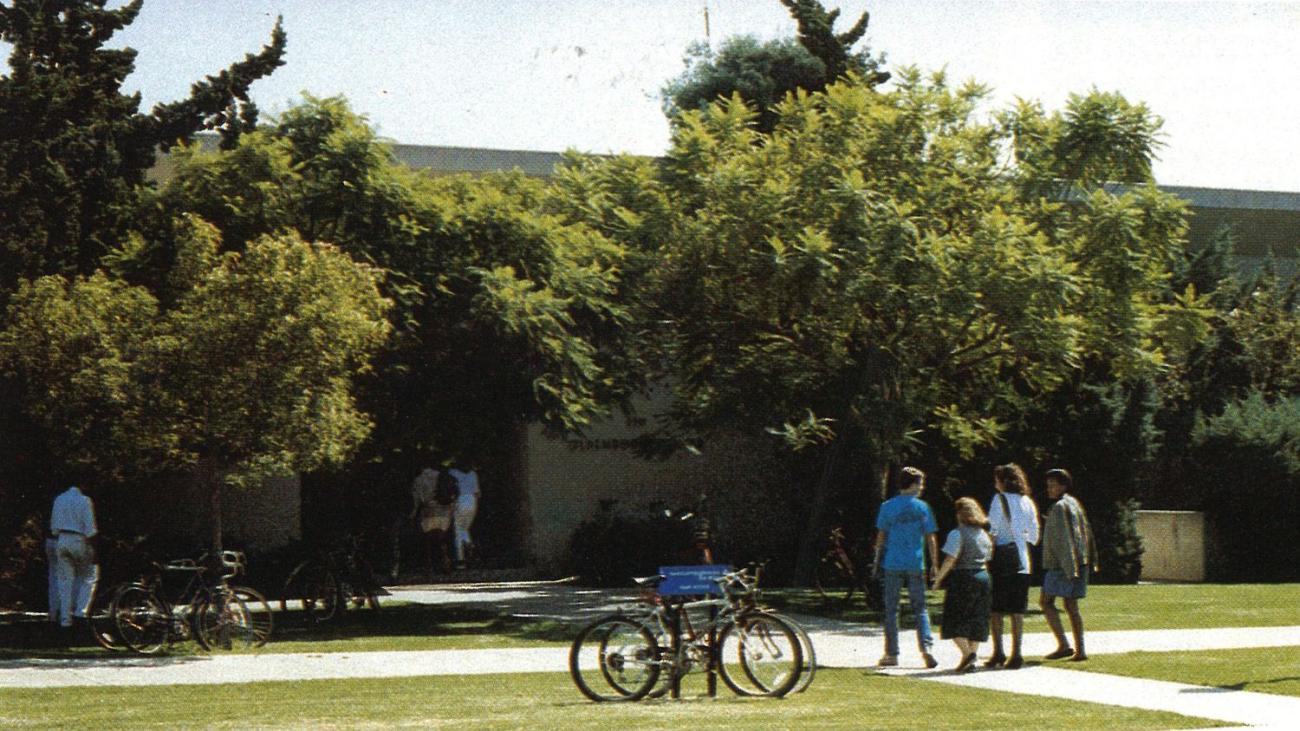
Sixty years of the Oldenborg Center — and a community built on the stories it continues to share.
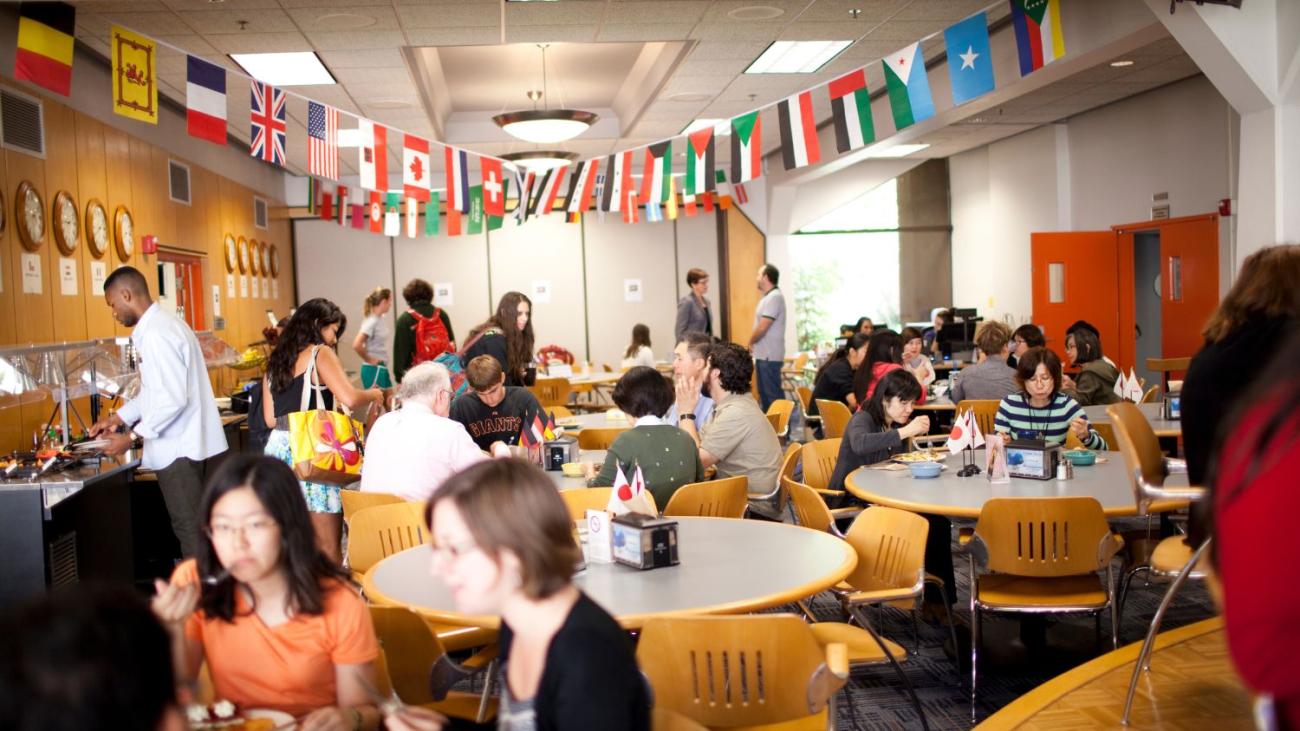
Alongside its living-learning community, the language tables have served as a central place for conversation, culture and connection.
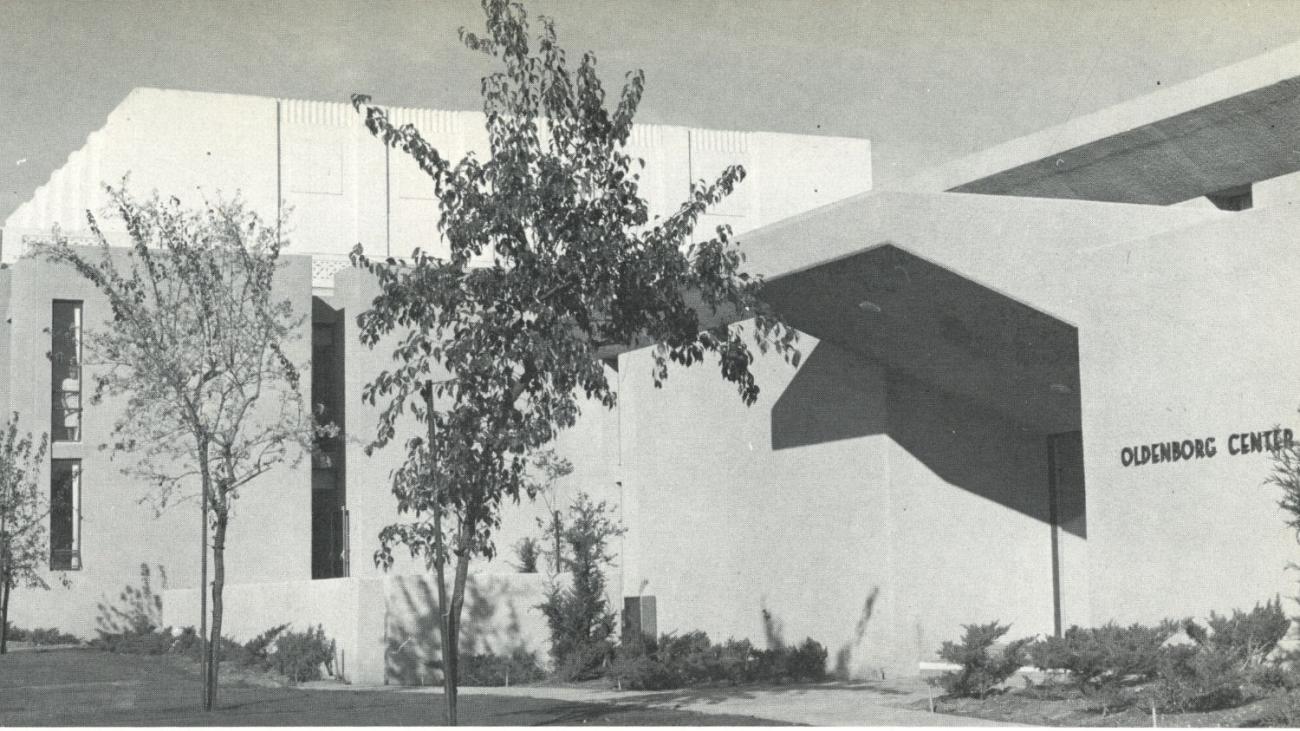
Opened in 1966, the living-learning hub was the first of its kind in the nation — and remains one of a kind.
Throughout the spring semester, Pomona College invited students, alumni, families and friends to share their memories as part of the “Dear Oldenborg” series, collecting reflections that speak to the center’s impact on campus life and community.
Just like the mosaic, these submissions come together to form a larger portrait of Oldenborg — each one a piece of a shared history. Here’s what we heard:
I have fond memories of countless lunches at the Hindi/Urdu table and Spanish table. The Spanish table took me out of my comfort zone and put me in an immersive language learning environment that really enhanced my language learning in my Spanish courses. The Hindi/Urdu table did the opposite. It gave me a weekly opportunity to sit and converse in my native language and spend time with my South Asian community at the 5Cs, feeling just a bit closer to home. — Kavisha Singh ’10
I can’t imagine Pomona without Oldenborg. It wasn’t just language tables, or anything formal. It was an energy of international and global reflection and awareness that permeated the place. I lived there during the Vietnam War, which was a time of global engagement — or rather, disengagement. Language and culture permeated the environment, and students found like-minded souls. Discussions in lounges and elsewhere made the center a place that was unique in the Claremont Colleges. — David Shallenberger ’72
I was Assistant Director (1999-2002) and Acting Director (2002-2004) at Oldenborg, and also served — until a replacement could be found in December 2004 — as PDSO and RO for F and J visa students on campus. My time there was very important, not only to me, but to my German husband and our son. The Language Residents were so inspiring, and we were able to spend a lot of time with them at events on campus and at home outside of working hours.
We grew especially close to the Spanish and German residents because of shared languages and backgrounds, and eventually the Japanese resident became very influential to our son, who went on to study Japanese. While taking a summer course in Japan during high school, he was taken out to lunch by a member of Pomona’s Japanese faculty, also an inspiration. Although now a pharmacist, he still speaks Japanese, and he often takes evening classes in Spanish and German. His childhood at Oldenborg truly opened his world, and for that, our family is very grateful. — Patricia Guenther-Gleason
Oldenborg was my home at Pomona. From the parties at the Russian section to the late nights playing mafia with my fellow Chinese learners, and even a brief dalliance with a Spanish language resident that definitely got in the way of my classwork. Oldenborg was the place where I discovered new cultures, found love and made lifelong friends. Twenty years later, it’s hard to imagine a Pomona without Oldenborg. — Leila Tovbina ’06
I lived in Oldenborg my sophomore year, complete with a contest to design the Oldenborg t-shirt. Near the deadline, there hadn’t been any submissions, so someone had pinned a drawing of smiling stick figures on the dorm bulletin board with a note that said, “This will be the t-shirt if we don't get any submissions!”
I decided to submit a design, figuring there wouldn’t be any competition, and created a “Raiders of the Lost Dorm” design, riffing on the fact that it was often easy to get lost in Oldenborg’s halls (it was the ’80s, so the Raiders of the Lost Ark movies were a big thing). When it came time for everyone to vote, there were only two entries: mine and the stick figure drawing and text. My design lost to the stick figures, and now I can’t remember if I bought the t-shirt for the absurdity factor, or refused to buy it out of spite. — Leslie Wolber Proudfit ’87
This year is my first year after leaving Oldenborg. I still find myself thinking about it, from time to time. I miss the people and all the moments there. It was the first place in the U.S. that really felt like my own small home. At the beginning, it felt a little empty. But slowly, it was filled-with students, with friends and with memories. It became warm. The Lounge was where our conversation classes happened. I saw students trying to speak Chinese in their own ways, sometimes unsure, sometimes creative.
There was a lot of laughter, and many small moments that stayed with me. In the kitchen, there are traces of my not-so-successful cooking of Chinese food, along with memories of students coming over shortly after, and all of us making a mess together, laughing about it. In the living room, there were quiet nights and happy gatherings. And my room was my own space, a place to prepare for classes, to rest and to think a little more about myself and my future.
I often think about Language Table. At the beginning, I was really nervous, but later, it became one of the parts I felt closest to. I’m very grateful to everyone who came, sat down and tried to speak Mandarin. We talked about simple things — about culture and sometimes random things. Sometimes I joked that I felt like a bride at a wedding, moving from table to table to “make toasts” (it’s a Chinese wedding tradition).
Oldenborg was not only a place where I worked. It was also where I lived. I met students, colleagues and friends there. We lived in the same building, making it easy to visit each other. That kind of closeness is something I truly treasure. I’m also very grateful to the Oldenborg team. Being far away from home, their support made me feel safe. I feel that Oldenborg is a very special place. It connects both people and languages. People come here, find a sense of belonging and connect with each other.
There, I experienced many “first times.” My first real job. My first long time living abroad. My first time meeting people from so many different places and backgrounds. It slowly changed how I see the world. For me, it is not just a building. It holds so many memories and completely changed my life. And it is something I will always carry with me. Even if the space is gone, the memories will stay. Oldenborg will always be in my heart. — Manxi (Marcy) Wang
Oldenborg opened in 1966, halfway through my time at Pomona. Many of us, by that time, had moved off campus, because of a shortage of on-campus housing (first year of the baby boom, after all). Oldenborg was a focus for some of us to keep connected to the rest of the on-campus community. For me, it was jamming in the basement where instruments, amps (of various sorts) and other gear, were kept for anyone to play. Very cool! The main instigator / “coordinator!” / participator was Kim Guggenheim, who actually was really good. Most of us were not so good, but had a lot of fun and learned a bit, too, about the music and the community, during a period when that was increasingly hard to find. — Robert Stier ’68
I literally have tears in my eyes writing this just after getting the news that Oldenborg will soon be existing only in history. More than a simple dormitory, thinking back to some of my most treasured years, Oldenborg forms part of my identity. I was so fortunate to be part of (to the best of my knowledge) the final class that would have first-years stay in Oldenborg, and so every year of my time at Pomona was in Oldenborg. The environment and community were so important to me, not only in my sponsor group but in the Japanese section and visiting the other language sections. The comradery shared by all of us, motivated by language and cultural study, were paramount in finding my identity in this new, wonderful place.
I was moved to become the dorm president in my sophomore year and had pride in helping organize some of the kinds of events I had come to appreciate in all six sections, which became beacons for students of all colleges to come and experience something new and profound. After an academic year in Kyoto, I chose my ideal room for my senior year, right next to the Japanese lounge. Keeping my door open for passers-by, I was so happy to share the bit I had learned with the younger students interested in the culture. Being in that hall was so vital, as I found myself a bit overwhelmed with my thesis and can humbly say that I could barely get it together in time to meet graduation. Along with the efforts of my professors, I can look back knowing that it was the emotional support and understanding of fellow students and the language resident to get me across the finish line.
On the subject of language residents, they were the most unique and perhaps the most valuable asset of Oldenborg. Of course, I was so fortunate to be bonded with and positively impacted by the Japanese language residents, to the point of staying in touch and meeting again after moving to this country. But also, I had the chance to share so much with residents of all language sections, and through them really get a feel for ways of thinking and places that I had never seen and have not had the chance to see even to this day.
Thinking back, I remember every part of the building at the time...the sound of the access card beep and door lock opening; the smell, that initial savory start of cooking near 11 a.m. on weekdays; the troubling vibration of that one machine in the north laundry room that I hope has been replaced or fixed in the last 20 years; the deep concrete bowels of the building which may have been the coolest place on campus on a hot day; the table and chair in front of the theater door, which was the quietest place to study on a weekday night. There are places of passion and panic, of shared love and shared secrets. All these images and emotions have now come back strongly and will remain for the rest of my life even if those walls will soon no longer stand.
Moving across the ocean soon after graduation, I had the honor of visiting Oldenborg twice afterward, and my pride in its mission and in its purpose filled me again each time. I’m deeply saddened that I will not have the chance to see it again, but I hope that the next structure that takes its place will continue the wonderful traditions of language halls, language residents and language tables. However, it will take a number of years for the students and staff of this new place to develop the same legacy of Oldenborg in founding and fostering the international lives of hundreds of alumni like myself. Those are big shoes to fill. — Kent Phillips ’04
Not everyone I knew at Pomona was happy with the proposed design of Oldenborg. Around the time it opened, Mufti posted the sticky message “A mighty fortress is our god,” one of its best. And toy cannons appeared at the corners of Oldenborg’s roof — its cannon turrets — which were quickly removed. It’s possible that students and staff from more recent years don’t know about Mufti. — Paula Hui ’67
Although I lived in the Japanese section for two years and hung out a lot in the German section, perhaps Oldenborg’s greatest gift to me was launching my interest in American Sign Language. There was a wonderful woman named Trudie (I think) who agreed to be our resource person, and we met once or twice per week at the language tables. The rule was that the first thing you learned was fingerspelling, and once you knew that, you weren’t allowed to fingerspell anything but had to mime it out. I remember the student organizer trying to explain “Jewish” and at one point putting a small plate on his head to indicate a kippah. Of course, the table was largely silent until something funny happened, which was often, and then we would all erupt in laughter. People walking by were often startled by this, which was even funnier.
The student organizer attended Gallaudet University, the nation’s only four-year college for the deaf, for his semester abroad and when he got back, Trudie said, “I thought he’d become deaf!” He organized a performance by the National Theater for the Deaf at Pomona that was incredible, and we were all so excited to be invited backstage to chat with the performers afterwards and try out our ASL. I once met a Ugandan man who spoke a combination of U.S. and U.K. sign language, and I was the only person in the room besides his interpreter who could communicate with him directly. I’m now a professional counselor and studying hard so that I can provide services in ASL. There is an enormous need for more therapists who can serve deaf and hard-of-hearing people, and I’m sure I would never be one of them if it weren’t for that first exposure back in Oldenborg. — Carey McIntosh ’92
This story is an example of the extraordinary learning opportunities one can have at Pomona. After I took Leonard Pronko’s class on 20th century French theater of the avant-garde in the fall of 1968, and then Robert Leggewie’s class on 20th century French novel, I wanted to study more 20th century theater. I was shocked when Masago Armstrong (Registrar) told me there were no other classes in 20th century French Lit. So, I went to Professor Pronko and asked him if the plays we had read in his class were all there was that was worth studying. “Oh, my goodness no!” He rattled off names of playwrights. I answered “That’s who I want to study.”
After a few days of negotiating, he agreed to teach me more 20th century avant-garde French theater in a one-on-one setting. The deal was that I would read a couple of plays each week on my own, and then on Wednesday, we would have lunch at Oldenborg where I would “teach” him about the plays. In return, he would critique my views. Our weekly conversational-tutorial classes lasted both semesters and remain one of the highlights of my time at Pomona. — Gregory Frank Cook ’72
Oldenborg, thank you for giving me my best friend. Thank you for hosting our hour long talks in the suites, and then for letting us wait in your hallway when we would accidentally lock ourselves out. Within your walls I learned what it was to know friendship. — Camila Amaya Navarrete ’27
Moved into a labyrinth called Oldenborg in the fall of 1985. What a joy. Within a short time, I counted new friends from South Korea, Argentina, Germany and Czechia as my neighbors. The place had a vibe all on its own, and yes, folks regularly got lost. The dining hall hosted language lunches, the occasional party and even a few cultural events. It was an eccentric place at an esteemed institution, which felt just about right. The ’Borg may be going but won’t soon be forgotten. — Gary Lancina ’89
The language sections in Oldenborg had graduate RAs who helped organize cultural activities for each section. Lydia (if she had a last name I never knew it) was responsible for the Russian section. Since vodka was a major element of Russian culture and since the College campus drinking rules were not stringently followed, the frequent parties in the Russian section involved a certain amount of vodka, with which Lydia created a punch with champagne, white wine and ginger ale that was both potent and smooth. Lydia’s punch, as it has been known ever since, continues to be served to generations of Pomona College students; I passed the recipe onto my daughter (class of 2007) who served it at her wedding. — Michael Mahler ’74
I arrived at Oldenborg in 1998 as the French Language Resident. I discovered the French section in this incredible labyrinth-like building: the lounge, the appartement and the kitchen. At the time, Language Residents had to organize a ”Study Break” once a week for the students in their section. Since I wasn’t quite sure what would attract them, I decided to teach them how to make crêpes, how to flip them in or near the pan and flambé them. After all these years, many of the Oldenborg residents from that time have remained close friends. And they still talk to me about the disco dancing crêpes. — Thomas Vidal ’99
Oldenborg changed my life, for it was there that I met my future wife, Vicki Paterno ’75. I was in the French section, she was in the Italian section. We shared the language of love! — Michael Mahler ’74
I lived in Oldenborg for two years. The concept was great, and the execution of the concept was at least laudably aspirational. But the building was always unforgivably hideous. It’s a good thing it is being torn down. Too bad they gave in to the architectural fads of the time and built that monstrosity. — David Schraa ’72
Room 119 and a 44 year-old friendship began...how could the sponsors make a perfect roommate match before the age of AI? We understood each other’s humor, enjoyed similar movies, tortilla Española and Coop quesadillas. We laughed and she supported me when I lost my loved ones. I helped her clean out her mom’s skilled-nursing room and she helped me pack my family home to leave for a dream job. We’ve cheered each other on and were present for life’s milestones.
MIL GRACIAS Oldenborg por las oportunidades de hablar en español y aprender de otras culturas, de vivir en el dormitorio mas moderno del tiempo y de conocer amistades que han perdurado. Que dichosas hemos sido. — Mary Louise Baez ’86
Oldenborg was my favorite dorm in my four years at Pomona. Being able to live with people learning the same language and participating in fun activities organized by the Language Residents allowed me to prepare myself for my year abroad in Japan. The best thing was the Oldenborg Dining Hall. Not only was there always great food and conversations, it was just steps away from my Oldenborg room. I am honored to say that I was the winner of a $50 gift card and a certificate for having the highest attendance at Oldenborg Dining Hall (58 swipes in a semester!); basically a reward for being too lazy to walk to any other dining hall for lunch. — Yttrium Sua ’15
When I matriculated, I intended to be a translator. I had studied French and German in high school, so I applied to live in Oldenborg. The conversation groups were so much fun, especially when global foods were involved. I lived in a suite with three roommates. One had just come back from a year in Germany and we ended up performing in a German adaptation of “Amadeus,” in which I played Mozart; and Dürrenmatt’s “The Physicists,” a tragic comedy about spies, psychiatric care and nuclear physics.
My other two roommates were artists. One painted a mural on the wall of our suite. The other encouraged me to sign up for a class with painter Karl Benjamin. John studied biology and he kept a ball python in a terrarium. We tried to feed it mice, but they would curl up in the snake’s coils to nap. One night, while we were asleep, the snake escaped. That’s when we were abruptly called in for a disciplinary hearing. Dr. Samuel Yamashita was our advocate. They’d found ashes in the trash bin from a barbecue we had on the balcony and asked why we were playing the Talking Heads’ Burning Down the House so loudly. Dr. Yamashita explained that it was a popular song at the time. They asked us if we’d found the snake, worried that a giant python might be stalking Oldenborg students.
The two-and-a-half foot long snake turned up later, tucked into a tiny slot under our closet. We had the hardest time explaining my roommate’s wall mural quotation, “At least if the road to hell is paved, I can bring my car.” It referenced a declaration from 18th century theologian Jonathan Edwards.
We all liked Oldenborg’s Director, so it’s unclear why one of my roommates launched a whole pineapple into their courtyard, but it didn’t win us friends on the disciplinary council. In the end, they realized that at least three of us were dedicated students, participating in many parts of Oldenborg life and we got put on probation. Our wilder roommate got some kind of partial suspension. I’m still friends with two of those guys. My roommate, John, came to visit me in Ohio and brought me a beautiful typewriter that he’d restored. I’m sure he’d tell this story differently. What a fun year! — Fred Pierre ’89
During sophomore year, three friends and I lived in an Oldenborg quad. We were on the top (third) floor on the corner, and called our suite “The Penthouse.” Twenty years later, we are all still close friends and the name of our group chat is: The Penthouse. — Anne Shulock ’08
I stayed in the Chinese language hall 2000-2001. Part of the requirement of living there was a need to prepare a meal as a means of sharing the culture with the rest of the campus. The only issue was that I didn’t know how to cook, so it became of journey of learning, with limited success, ultimately culminating with my mom actually coming to campus to bail me out. I’m a much better cook these days but look fondly back on those earlier years. — Ken Hsin ’03
My research lab was looking for a building to model for an autonomous robot project. We wanted a space with some unusual characteristics (not just regular, straight hallways). My research assistants immediately added Oldenborg to our list of buildings to tour. It was the clear best fit, with its odd arrangement of ramps, stairs and hallways. — Anthony Clark
Do you have an Oldenborg story you’d still like to share? There is still time to submit additional memories for consideration by emailing alumni@pomona.edu.