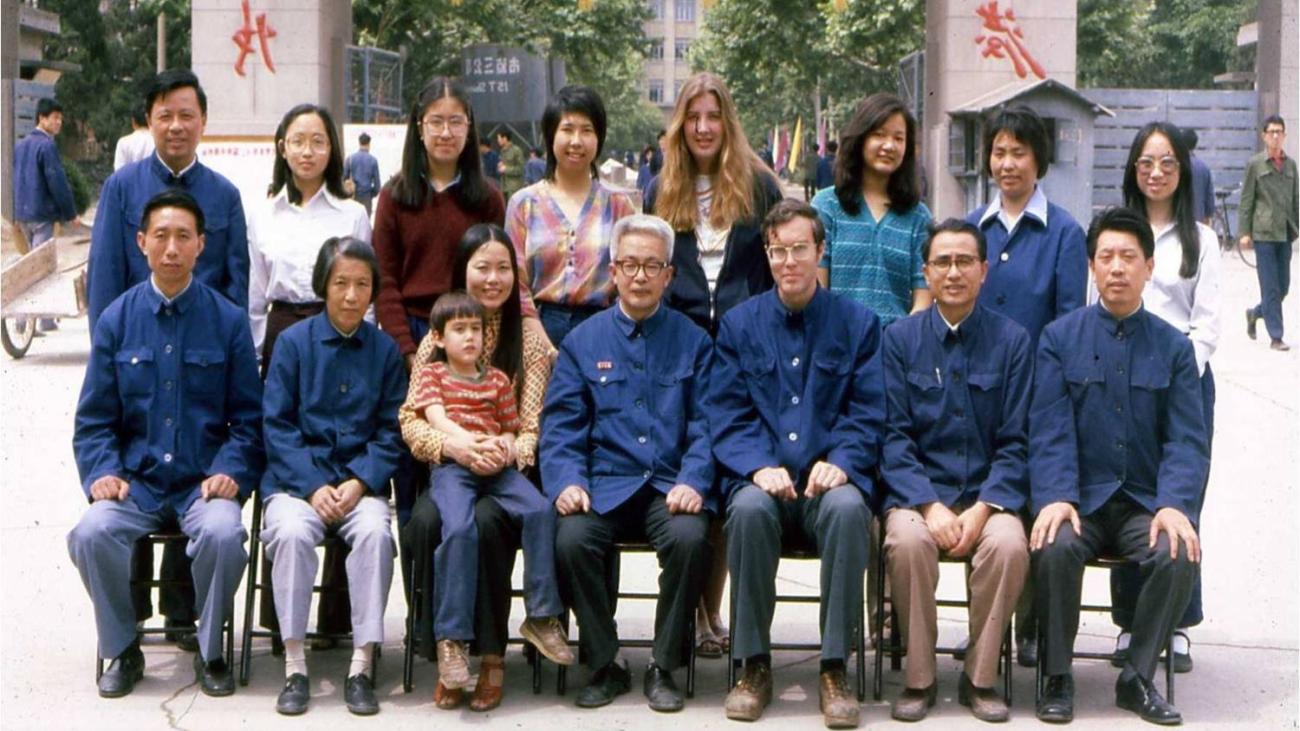
Pomona College professor David Elliott (bottom row, fifth from left) and wife, Mai (third from left), led a semester-long trip to China (1981). Today, Chiu‑Mi Lai ’83 and husband, David Mohrig ’83, are honoring the couple's impact on students with a gift.
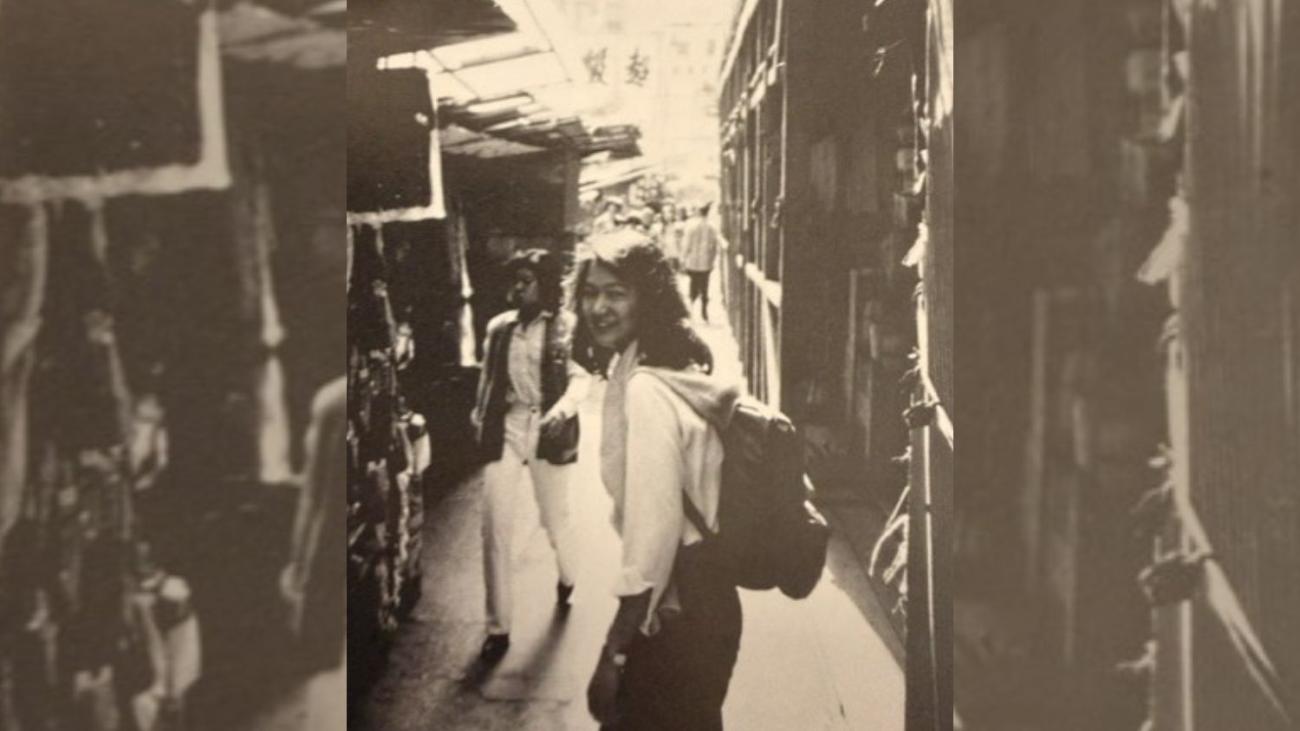
Chiu‑Mi Lai ’83, pictured here on her 1981 journey, reflects on a lesson that endured: “Learning happens in the classroom, but so much of what stays with you for the rest of your life happens outside of it.”
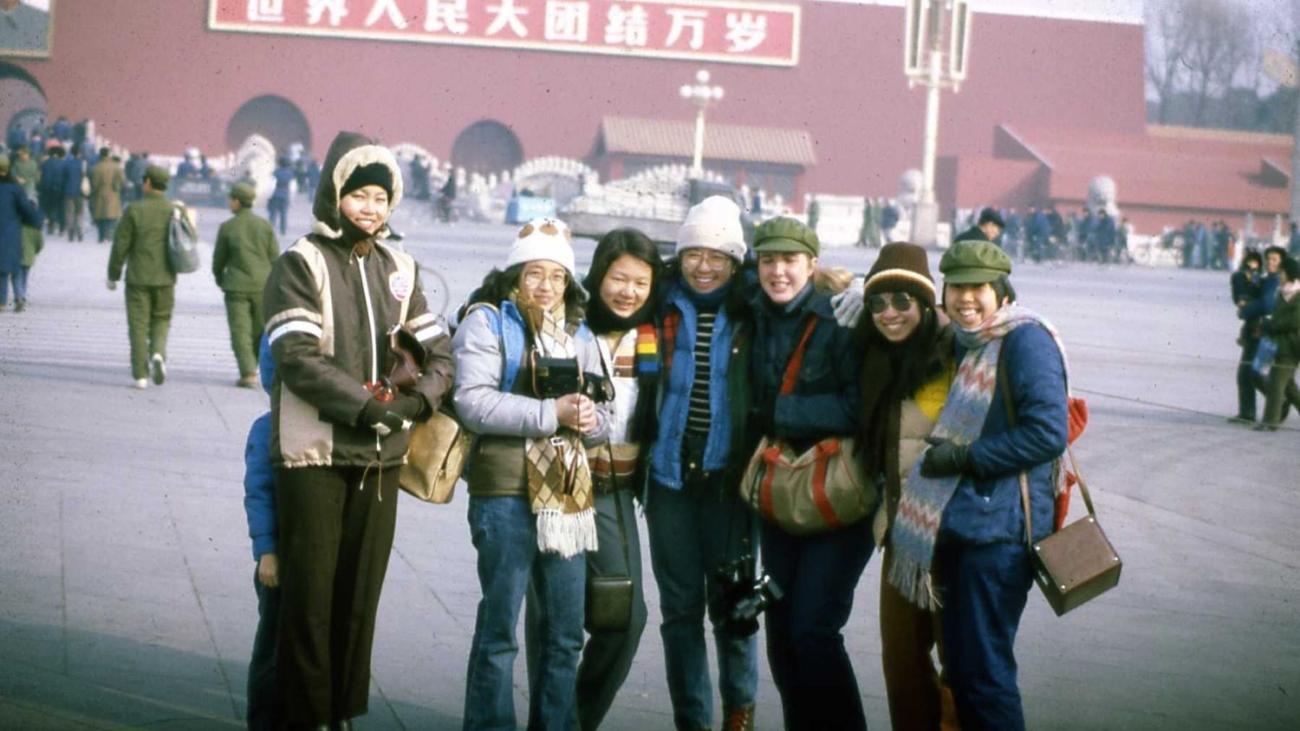
Pomona students visited Tiananmen Square in Beijing in 1981. Left to right: Mai Elliott (with son, Bryan, behind her); Jeanne Wong ’82; Lai; Rudi Jeung ’82; Janie Stoddard (Scripps) ’82 ; Jeannie Lee ’82; Tillie Fong (Pitzer) ’82.
When Chiu-Mi Lai ’83 boarded a train in Hong Kong bound for mainland China in 1981, she carried more books than luggage. She also carried a rare opportunity — to see a country that had only recently reopened to the world — and a growing conviction about the importance of a global education.
More than four decades later, that journey has come full circle in the form of a new gift to Pomona College.
Lai, along with her husband, David Mohrig ’83, established an endowed fund honoring Emeritus Professor of Politics David Elliott and his wife, Mai Elliott, whose mentorship left a lasting mark on her life.
“This gift is an acknowledgement of the impact a professor can have on students, which is the greatest reward for a teacher,” David Elliott says.
The fund will support Pomona students pursuing experiential learning opportunities in Asia, covering associated costs including travel, research and service projects.
“About half of Pomona students study away during their time at the College, and we are committed to expanding those opportunities so even more students can engage in the transformative learning that has long defined a Pomona education,” says Kara Godwin, assistant vice president and chief global officer.
Lai’s semester in China under the Elliotts’ guidance happened to be Pomona’s first study away program to Nanjing, during China’s economic reform. Travel within the country remained tightly restricted, requiring internal visas to move between provinces. Lai recalls lectures unfolding on trains, stacks of assigned books hauled overseas and the close-knit group navigating an unfamiliar world together.
“David and Mai had to manage everything — the courses, the travel, the bureaucracy — all with their five-year old son in tow,” Lai says. “Looking back now, I appreciate even more their mentorship and the sacrifice they made in taking us there.”
For David Elliott, the experience was just as formative.
“Whenever Mai and I reminisce about that trip, we remember the students’ joy and curiosity about a country they had known only through classes, articles and books,” he says. “Mostly, we remember the unfailing warmth and generosity of the Chinese people, who had so little at the time, yet showed resiliency, confidence and hope for the future. They were an inspiration to us.”
Although the Nanjing program marked a milestone, the College launched its first study away program to China in 1929. Former Pomona President Charles Edmunds, inspired by his time as president of Lingnan University in Guangzhou, sent 10 students on a yearlong educational expedition to China. The ambitious undertaking helped establish Asian studies as an emerging field at the College and signaled Pomona’s early commitment to global learning.
That pioneering spirit deepened with the founding of the Oldenborg Center for Modern Languages and International Relations in 1966 — the first of its kind in the nation — and continues as Oldenborg makes way for the Center for Global Engagement, scheduled to open fall 2028.
David Elliott, who joined Pomona’s faculty in 1977, is considered by many as one of the founding fathers of the College’s International Relations (IR) program. He retired in 2013 as the H. Russell Smith Professor of International Relations and Professor of Politics.
“David and Mai exemplified personal engagement with the world and the encounter with other cultures,” Pierre Englebert, the current H. Russell Smith Professor of International Relations and Professor of Politics, says. “David’s role in IR, Asian studies and the Pacific Basin Institute continue to influence Pomona faculty and students today.”
Together with his wife, Mai Elliott — a renowned scholar on Vietnam and the Vietnam War — they helped shape generations of students through scholarship, mentorship and global education.
Mai Elliott says she was surprised and deeply moved to be included in the gift.
“I enjoyed sharing a unique experience with the students,” she says. “I didn’t feel like a ‘faculty wife’— I felt part of the group, exploring a China that until then had been closed to outsiders like us. That Chiu-Mi felt close to me, as a friend and an integral part of the trip, is very precious to me.”
While the Elliotts’ mentorship proved formative, Mohrig and Lai say Pomona shaped the course of their lives in lasting ways. The couple met during their senior year at Pomona, and would go on to build careers in higher education. Before retiring at the end of this academic year, both taught at the University of Texas at Austin, where Lai was a professor of Asian Studies and Mohrig was a professor of Geology, regularly leading students on field research trips.
“Even at a much larger university, the faculty mentorship I experienced at Pomona deeply influenced how I interacted with my own students,” Mohrig says.
Lai said she shared the experiential lessons from her Pomona experience with her students, as well.
“These relationships that you make with classmates and faculty are more meaningful than you realize at the time,” she says. “Learning happens in the classroom, but so much of what stays with you for the rest of your life happens outside of it.”
To learn more about supporting study away opportunities for Pomona students, contact Kyle Davis, senior director of development.