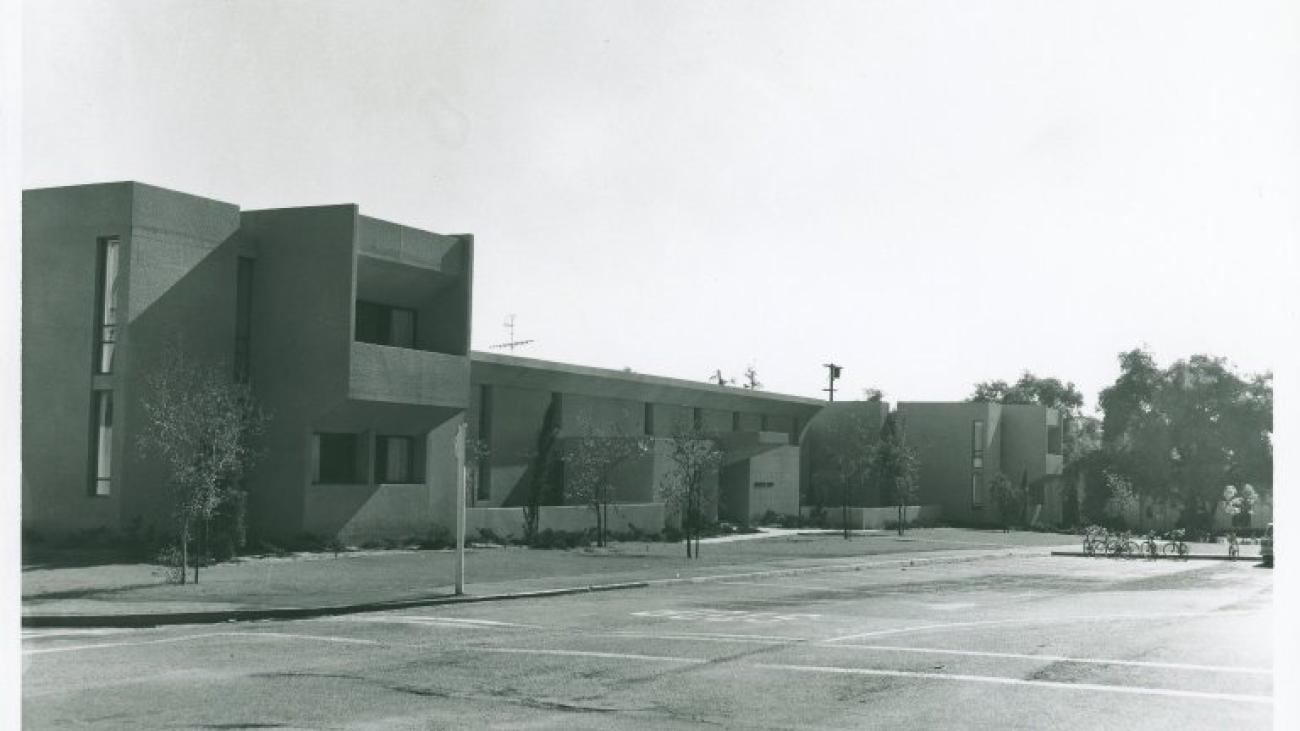
Opened in 1966, the Oldenborg Center was made possible by a $1.1 million gift from Diederick and Maisie Oldenborg — equivalent to about $12 million today.
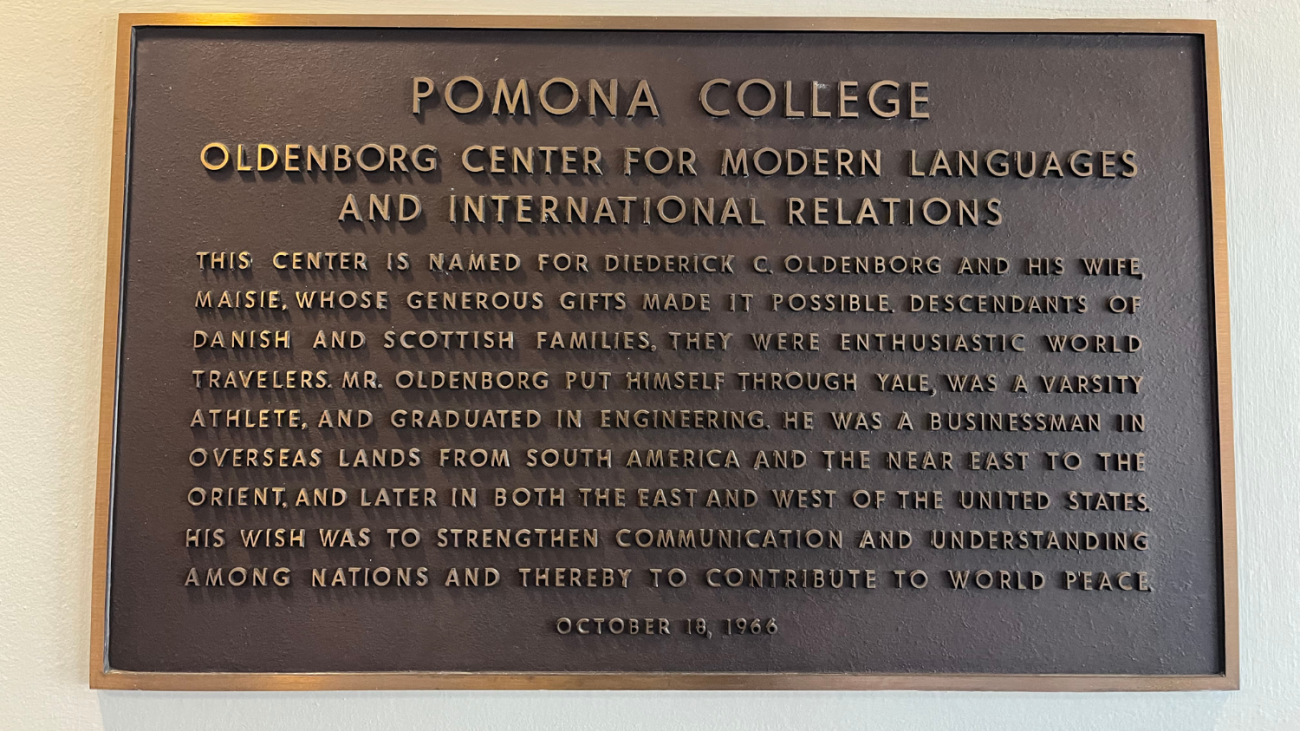
A plaque at the Oldenborg Center commemorates the building’s dedication on Oct. 18, 1966.
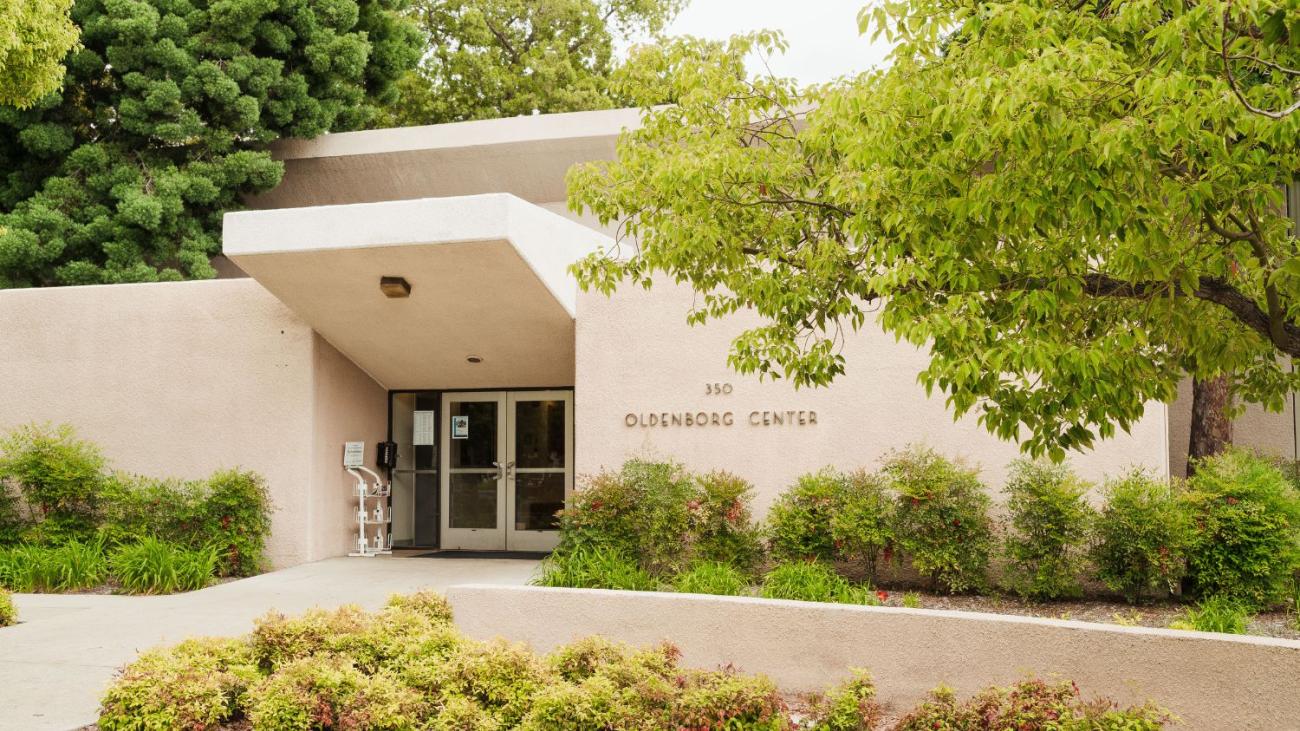
The Oldenborg Center, a first‑of‑its‑kind language and international residence, has helped define Pomona’s leadership in global education for 60 years.
The innovative concept of a residence center for students of foreign languages was warmly received by Diederick C. and Maisie Oldenborg.
Born in Denmark and raised in New York, Diederick Oldenborg was a businessman and enthusiastic world traveler whose goal as a philanthropist was to “strengthen communication and understanding among nations and thereby contribute to world peace.”
“It was a unique vision for an educational institution that Mr. Oldenborg had in the mid-sixties: to create friends around the world for the United States,” says Senem Bakar, interim director of the Oldenborg Center for Modern Languages and International Relations at Pomona College. “How do you do that? Through exposure to languages and cultures.”
In 1966, the center dedicated in his name was the first of its kind, combining a language center, international house and coeducational residence in a single building. In the 60 years since he helped establish the residential hub for language fluency and international relations, the Oldenborg Center has cemented Pomona as a nationally renowned leader in these areas.
As a young man, Diederick Oldenborg put himself through Yale, earning a degree in engineering and competing in varsity athletics. His business career spanned the globe, from South America to the Middle East and Asia, and later in both the east and west of the United States.
From extensive overseas travel with their daughters, the Oldenborgs developed an appreciation for the role that higher education could play in developing a better understanding among people.
Diederick Oldenborg came to know Pomona through his friendship with Allen Franklin Hawley, a 1916 graduate of the College and director of alumni and public relations at Pomona, who was a pioneer in the field of life-income gifts at non-profit institutions. Oldenborg’s experience abroad heightened his interest in Pomona’s need for new language and international relations facilities, and his family’s generous gift of $1.1 million was, at the time, the third largest in the history of the College.
Although other institutions, Columbia and Berkeley among them at the time, had centers for International students, and many others had modest language houses, no other American college or university offered a dormitory designed for the practice and use of languages.
The idea for this integrated center was developed by what was then Pomona’s department of Modern European Languages and Literature and by Deans J. Edward Sanders, Shelton Beatty and Jean Walton, with the support of President E. Wilson Lyon.
Diederick and Maisie Oldenborg visited campus and reviewed the plans for the center with Hawley and President Lyon. Construction began on Oct. 2, 1965, and the dedication took place on Oct. 18, 1966. The first students moved in on Nov. 2, 1966.
“I was fortunate to live in Oldenborg the year it opened,” recounts Erma Manoncourt ’70, global humanitarian leader and lifelong public health advocate. “It was absolutely cutting-edge — sharp lines, very modern facilities. I remember arriving and getting my room assignment, and we all felt so special because it was the first time we were coming together, bringing our individual expertise across different languages.”
Unfortunately, Diederick Oldenborg did not live to see the completion of the building dedicated in his name. At a luncheon following the next convocation, Maisie was the guest of honor. She was accompanied by their daughters, Maisie Barber and Elisabeth Oldenborg, son-in-law George Barber and three grandchildren.
Maisie Oldenborg remained vitally involved in the center and its programs until her death in December 1984. Subsequently, Maisie Barber and her family continued the Oldenborgs’ tradition of stewarding and supporting the center.
The original Oldenborg concept, unique in American education at the time, insisted that meaningful study of language and international relations involve personal, day-to-day living experiences as well as a strong and varied program of coursework. Today’s Oldenborg, with its range of co-curricular and residential programs, remains true to that mission.
“Through their friendships, philanthropy and forward-thinking commitment to international education, the Oldenborgs were pioneers whose legacy helped shape global learning in higher education,” Bakar says. “It is a story we are all proud to be a part of today.”
This is part of the “Dear Oldenborg” story series, as the College bids farewell to the Oldenborg Center. Help celebrate its legacy by submitting your photos and memories, and plan to join us in Claremont for Alumni Weekend 2026.